Visiting Space Center Houston with Kids: Ages, Tips & What They'll Love
What age is Space Center Houston best for? An honest age-by-age breakdown, family logistics, tram tips for kids, and how to avoid the most common parent regrets.
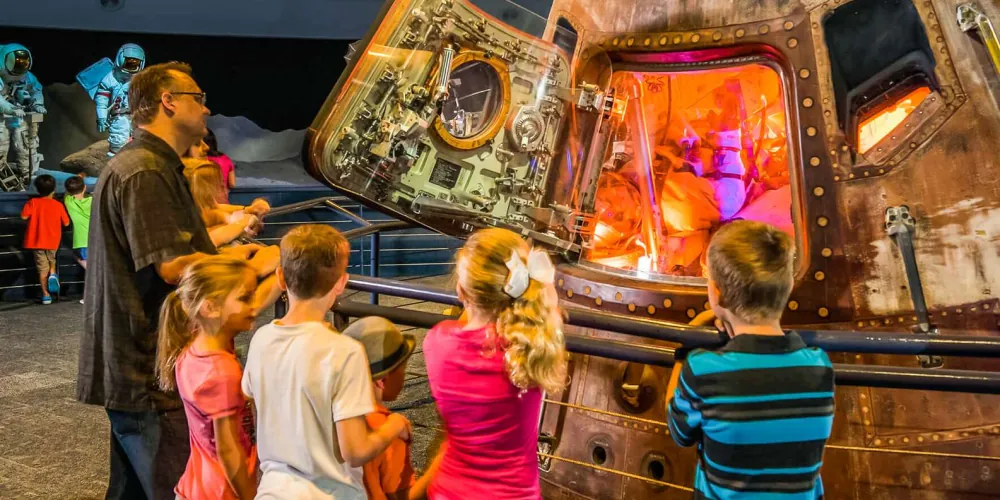
The most common parent regret on TripAdvisor is one of two things: arriving too late and missing the tram, or paying full price for a 4-year-old who never got past the indoor play area.
Both are easy to avoid. This guide gives you the honest age-by-age breakdown, the family logistics you need, and the order of the day that makes the difference between a great visit and an expensive disappointment.
Book your family visit online. Children 3 and under are free but still need a timed ticket. Ages 4–11 pay the child price. Age 12 and up pays the adult price — worth knowing before you budget. The Space Center Houston Admission Ticket (from $29, 4.5★ · 3,866 reviews) is the official timed-entry ticket with free cancellation, and our tickets guide has every price tier.
Quick Age Guide
| Age | Worth going? | What they’ll love | Tram suitable? |
|---|---|---|---|
| Under 3 | Free — low-key | Being carried through, maybe a nap in Starship Gallery | No — too long |
| 3–4 | Marginal | Indoor play area, big rockets, moon rock | No for most |
| 5–7 | Yes, strongly | Shuttle replica, Saturn V, hands-on exhibits | Maybe — short attention |
| 8–12 | Best age | Everything, including the tram and Mission Control | Yes |
| 13–17 | Depends on interest | Enthusiasts love it; non-fans may finish in 2 hours | Yes |
The sweet spot is 8–12. Old enough to sit through a 60-minute open-air tram and understand what they’re seeing, young enough to find it thrilling.
Age by Age, Honestly
Under 2
Free admission (under 3 is always free), but there’s very little aimed at them. The dark Starship Gallery makes a reasonable stroller nap spot. Beyond that, they’re passengers for the day.
Worth going? Only if the rest of the family is visiting anyway.
Ages 2–4
Children 3 and under are free; age 4 pays the child price.
The best case for this age is the Kids Space Place play area, with a multi-level indoor structure, slides and foam-ball launchers that keep little ones busy. The climb structure has a posted height limit and isn’t recommended for the very youngest, so check it on the day before promising it to a 2- or 3-year-old. Kids this age also love the big Saturn V rocket and can touch a real moon rock. That’s the ceiling of a fulfilling visit for a typical 3- or 4-year-old.
One parent put it plainly in a TripAdvisor review: “There is a great indoor playground/soft park… Beyond that there was not much else for them to do. I’d say it’s more of a place for 5 year olds and up.”
Worth going? If they’re under 3 and free: yes, for a half-day. If you’re paying child price for a 4-year-old expecting a full day, temper expectations — the play area is the main event.
Ages 5–8
This is where it starts working. Kids this age engage with the shuttle replica you can walk through, the Saturn V at full scale, the hands-on activities and the live presentations. Multiple guides call it “hugely worthwhile for ages 5 and up.”
They may still tire before seeing everything, and a 60-minute open-air tram can be long — but an engaged 6- or 7-year-old who loves space will have a fantastic day.
What to prioritise: the shuttle replica at Independence Plaza, the Saturn V at Rocket Park, the live Stellar Science Show (kids can volunteer for experiments), and Kids Space Place for a reset.
Ages 8–12 — the Sweet Spot
The full experience is open to them. Tram tour: yes. Mission Control presentation: yes. Films and live shows: yes. Saturn V and everything in the main building: yes.
The tram to the Astronaut Training Facility, where they look down over the mockups astronauts train on, is consistently what kids this age remember most.
One parent: “It reinvigorated my 9-year-old’s love for all things space.”
Note on pricing: age 12 pays the adult rate, not the child rate. Budget accordingly — it’s a meaningful jump.
Ages 13–17
Mixed, and more about personality than age.
Space-interested teens engage deeply, and at 14+ they’re eligible for the premium Level 9 VIP Tour when it runs (it has been listed as unavailable — check before you plan around it). The roughly $15 Historic Mission Control add-on works well for teens who’ve read about Apollo; the NASA Historic Mission Control Tram Tour + General Admission (from $100, 4.8★ · 173 reviews) books it with admission in one go, and our Apollo missions guide is good reading on the drive down.
Teens who aren’t already interested in space may find the main visitor floor feels pitched at younger kids. Multiple parents flag this in reviews: “Made for younger kids, not so much teenagers.”
If your teen isn’t a space fan: consider a half-day, not a full day, or combine the visit with Kemah Boardwalk for variety.
Other Experiences Worth Pairing With Your Visit
With children, the hard parts of the day are the drive, the heat and the tram queue, and a few bookings take some of that off your plate. A round-trip shuttle from downtown Houston (from $67, 4.8★ · 304 reviews) bundles admission with transport, so nobody has to drive home tired; a NASA-expert-guided visit (from $96, 4.7★ · 62 reviews) handles tram strategy and keeps older kids engaged with the stories behind the hardware. If the family is doing more of the city, the Houston CityPASS (from $72, 4.6★ · 266 reviews) folds the Space Center in with the Houston Zoo, the Downtown Aquarium and the Museum District, and Kemah Boardwalk, with its rides and waterfront restaurants, is about 15 minutes down the road.
The Tram Tour with Kids
The tram is the highlight of the whole visit — and the biggest logistical challenge for families.
What you need to know:
- Trams are open-air — no air conditioning, exposed to Texas heat in summer
- Each tour is 60–90 minutes of mostly sitting and listening
- Strollers are not allowed. There is a stroller-parking area beside the queue, and your stroller stays there while you ride
- Boarding passes are first-come-first-served — you collect them at Guest Services or through the app once you’re on-site. They cannot be booked online in advance for the three free routes
- The most popular route — the Astronaut Training Facility — can run out by around midday on busy days
For families with young children:
- Most parents recommend the tram for ages 8+. Below that, it depends on the individual child — one parent described a 4- and 2-year-old who “hung in there” on a 90-minute tour; others describe restless, unhappy toddlers
- Limited restroom access during the tour — go before boarding
- A “cry room” is available on some trams for disruptive little ones
The rule that separates good family visits from frustrating ones:
Arrive at opening. Before anything else — before exhibits, before the gift shop, before coffee — go straight to Guest Services and get your tram boarding pass.
See the full guide: the NASA Tram Tour explained.
What Kids Specifically Love
Independence Plaza — the Shuttle on the 747
Walking through a full-scale space shuttle replica mounted on top of the actual NASA 905 Boeing 747 shuttle carrier. You enter the shuttle first, walk the flight deck and mid-deck, then descend through the aircraft. The scale consistently delivers awe.
Good from age 5. Height and enclosed spaces can bother sensitive children. The access tower’s elevators have been out of service, leaving stairs only — leave the stroller at the base and check the current status if anyone in the family can’t manage several flights.
See: Independence Plaza.
The Saturn V at Rocket Park
363 feet of genuine flight-ready hardware, lying horizontally so you can walk its full length. Parents almost universally report that kids are stopped in their tracks by the scale in a way they hadn’t expected.
Good from age 5. Air-conditioned building — a real relief in summer.
See: Rocket Park and the Saturn V.
The Moon Rock
In the Lunar Samples Vault in Starship Gallery, there’s a touchable slice of Apollo 17 basalt — a real piece of the Moon. You reach through an opening in the case and touch it with one finger.
Kids reliably love this. It is a piece of another world.
See: Real Moon Rocks.
The Astronaut Training Facility Tram
Looking down from an elevated walkway over the ISS mockups, Orion capsule, lunar lander cabin and robots where real astronauts train. Sometimes astronauts and engineers are working below you.
Best for ages 8+ who can absorb what they’re seeing and stay interested through the ride.
Kids Space Place
The dedicated children’s area, with a multi-level indoor climb structure, foam-ball launchers and interactive STEM exhibits, including weighing yourself on other planets. This is the reset button for an afternoon when younger kids are flagging.
Included with admission. The climb structure has a height limit and isn’t recommended for under-4s.
The Stellar Science Show and Live Presentations
Rotating live shows include a hands-on science demonstration where kids can volunteer. Astronauts give 30-minute talks on Friday and Saturday mornings.
Check the daily schedule for what’s on.
What Can Frighten Kids
A few honest flags parents raise:
- The Blast-Off launch presentation is loud and standing-room-only. Some young children are frightened by it
- Starship Gallery is quite dark — the low lighting protects the artifacts, but kids who are afraid of the dark may be unsettled
- The shuttle and Skylab mockup interiors are enclosed and can feel tight
- Independence Plaza involves several stories of height — the open vestibules between levels can unsettle height-sensitive children
- The Mission Control presentation is calm and narrated — not frightening for most ages
Practical Family Logistics
Strollers
Welcome throughout the main building. Independence Plaza is tight in places, and with its elevators out of service it’s stairs only.
Strollers must be left at stroller parking before the tram. Guest Services has listed strollers for rent, but availability isn’t guaranteed and current official pages don’t confirm it — bring your own if you can.
Nursing and Changing
A private nursing room sits between The Food Lab and the Space Center Theater entrance in the Astronaut Gallery. Nursing is also permitted anywhere in the building under Texas law.
Family restrooms are in The Food Lab. An adult changing area is available on request.
Food
The Food Lab food court has the predictable museum pricing — parents describe $60 family lunches for nothing remarkable.
Three options that soften the cost:
- Eat a big breakfast before you go
- Use the picnic area outside near the parking lot — outside food isn’t allowed inside (except for documented dietary or medical needs), but you can bring a cooler to the picnic tables
- Use your same-day re-entry privilege — get a hand stamp at Guest Services, drive to Clear Lake or Kemah for a cheaper lunch, and come back. This is explicitly permitted and saves real money for families
Sensory-Friendly Options
Space Center Houston is a Certified Autism Center.
Year-round: free sensory backpacks at Guest Services contain noise-reducing headphones, sunglasses, fidgets and a visual schedule. A quiet room is available on request.
Periodic Sensory Friendly Events (presented by THINK Neurology for Kids) run with modified lighting, limited attendance and trained staff. Admission at these events is reduced to $15.95 (free for members and children under 3). Registration opens one month before each event.
More accessibility detail is in our hours, parking and planning guide.
Overnight Family Campouts
For families with kids 5 and up: Family Campout overnights include a welcome briefing, STEM activities (rocketry, robotics, astronaut-training tasks), dinner, overnight camping among the exhibits (under the Falcon 9 or in Independence Plaza), breakfast, a tram tour, and a second-day visit. Prices have run from roughly $60 to $80 per person depending on the programme and date — our discount tickets guide covers the overnight options.
Reviews are very positive, and these sell out. Register at least four weeks ahead.
Scout Camp-Ins and American Heritage Girl Camp-Ins are also offered.
Simulators
Motion and VR simulators cost $8–$10 extra per person and are not included in admission.
The Infinite VR requires children to be at least 8, with a parent signing a waiver for ages 8–12. Children under 48 inches are excluded from some motion simulators. Height limits are posted on-site.
The Ticket Price Trap Families Miss
Age 12 pays adult price. There is no tween or teen tier.
If you’re planning with a 12- or 13-year-old, budget at adult rates. A family of two adults and two children aged 12 and 9 pays three adult prices and one child price.
Children 3 and under are free but still need a timed ticket reserved online.
Membership vs. Tickets for Families
Family membership (~$149) covers up to four family members, with free admission for 12 months, free parking every visit, express entry, and advance booking access for the Historic Mission Control tram.
A single family visit with two adults and two children (ages 4–11) plus $10 parking typically costs $110–$140 depending on the date.
Membership pays for itself on the second visit. If you live in the Houston area or plan to return within a year, consider buying membership on arrival — Space Center Houston allows visitors who bought tickets within the previous two weeks to convert that purchase to a membership. Our tickets guide has the membership tiers.
For out-of-town families visiting once: compare the Houston CityPASS if you’re hitting three or more Houston attractions; otherwise a single online ticket is the right call.
Recommended Order of a Family Day
- Arrive at opening. Weekday mornings in spring or fall are among the least crowded times; summer and spring break are busier — see our best time to visit guide.
- Straight to Guest Services for your Astronaut Training Facility tram boarding pass.
- Starship Gallery — moon rock, Apollo command module, hands-on exhibits, and the introductory film for context.
- Tram tour at your allocated time.
- Independence Plaza (the shuttle on the 747) — allow 45 minutes.
- Lunch break — either the Food Lab or leave and re-enter for somewhere cheaper.
- Kids Space Place for a reset if younger children need it.
- Live show or film and any remaining galleries.
- Gift shop — at least an hour before closing.
Total: plan 5–6 hours. Most families with elementary-age children could easily fill a full day. If you’re still deciding whether the day is worth the cost, our honest review round-up covers what visitors love and what they don’t.
Book your family tickets. Children under 3 are free, ages 4–11 pay the child price, and buying online saves about $5 per ticket over the gate. Add Historic Mission Control if your kids are 8+ — pricing and booking.
Frequently Asked Questions
What age is Space Center Houston best for?
The sweet spot is roughly 8–12. Children that age can fully enjoy the tram tour, understand what they’re seeing at Mission Control and the Saturn V, and engage with the live shows. Children 5 and up get strong value. Under-5s enjoy the play area and big rockets but miss most of the content.
Is Space Center Houston worth it with toddlers?
Children 3 and under are free, so there’s no financial risk. A 2- or 3-year-old will enjoy the scale of the rockets and parts of the play area, though the climb structure has a height limit. If you’re paying child price for a 4-year-old, go in knowing the play area will be the main event and plan for a half-day, not a full one.
Can you take a stroller to Space Center Houston?
Yes, strollers are welcome throughout the main building. They must be left at the stroller-parking area before boarding any tram tour, and Independence Plaza is currently stairs only while its elevators are out of service. On-site stroller rental isn’t reliably confirmed — bring your own if you can.
Is the NASA tram tour suitable for young children?
The tram is 60–90 minutes of open-air, largely narrated sitting. Most parents recommend it for ages 8 and up. Younger children can manage it, but it depends on the individual child — toddlers and under-5s often get restless. Strollers are not allowed on the tram.
Are there sensory-friendly options at Space Center Houston?
Yes. Space Center Houston is a Certified Autism Center. Free sensory backpacks (headphones, sunglasses, fidgets) are available at Guest Services year-round, and a quiet room is available on request. Periodic Sensory Friendly Events run with modified lighting, limited attendance and reduced admission ($15.95; free for members). Registration opens one month ahead.
What is Kids Space Place?
The dedicated children’s area inside Space Center Houston, featuring a multi-level indoor climb structure with slides and foam-ball launchers, plus interactive STEM exhibits. It’s included with general admission and works well as an afternoon reset for younger children whose energy is flagging.
Does age 12 pay child or adult price?
Adult price. The child ticket rate applies to ages 4–11 only. Age 12 and up pays full adult admission — a common budget surprise for families with preteens. Children 3 and under are always free.
Is family membership worth it?
For families who will visit twice within a year — yes, clearly. The Family Membership covers free admission for up to four family members plus free parking every visit, and it pays for itself on the second visit. Space Center Houston allows the cost of a recent ticket purchase to be applied toward membership.
See NASA's Home of Human Spaceflight
Join the visitors who rate Space Center Houston a highlight of their trip — the Saturn V rocket, Historic Mission Control, the world's largest public moon-rock collection, and Independence Plaza. Reserve timed admission with free cancellation.
Check Availability & Book