Johnson Space Center vs Space Center Houston: What's the Difference?
Johnson Space Center is NASA's working facility and closed to the public. Space Center Houston is the museum you can visit. Here's exactly how they differ.
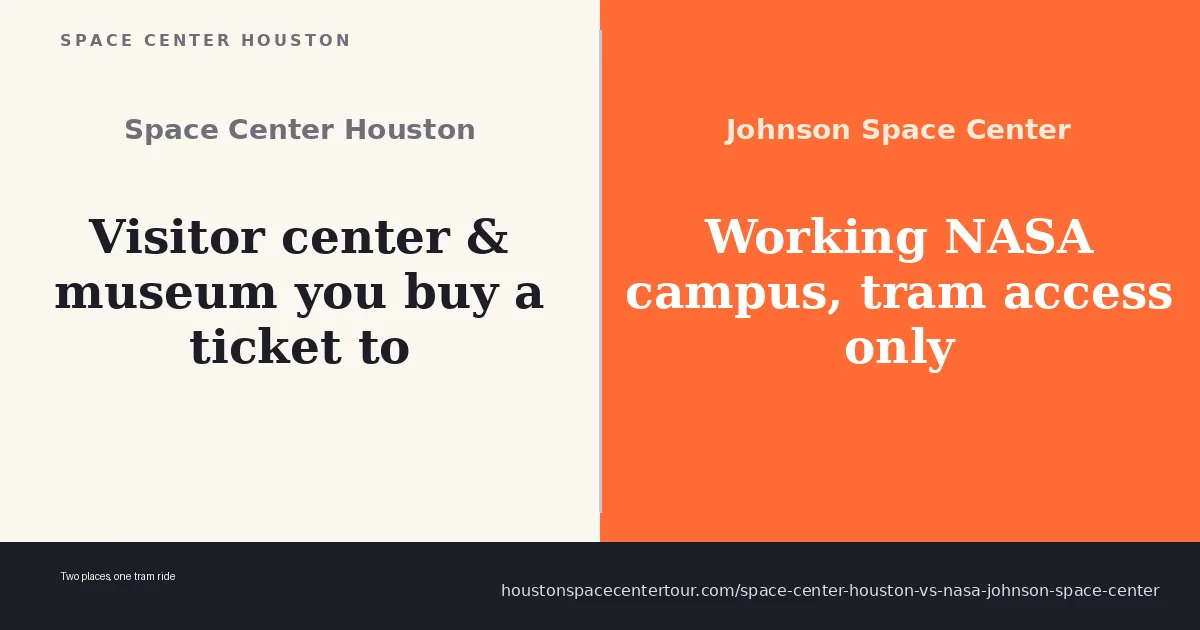
The short answer: they’re two different organisations at one location. NASA Johnson Space Center is a working federal facility — Mission Control, astronaut training — and it is not open to the public. Space Center Houston is the museum next door, run by an independent nonprofit, and it’s where you buy a ticket and go.
If you’re planning a visit, booking tickets, or setting a GPS, you want Space Center Houston.
That distinction sounds simple, but it causes real problems: people search for “Johnson Space Center tickets” that don’t exist, drive to a NASA security gate that turns them away, and arrive expecting to walk into Mission Control. Here’s the full picture.
Side by Side
| NASA Johnson Space Center | Space Center Houston | |
|---|---|---|
| What it is | Working NASA field centre | Science museum & visitor centre |
| Who runs it | U.S. federal government (NASA) | Manned Space Flight Education Foundation, a 501(c)(3) nonprofit |
| Open to the public? | No | Yes |
| Can you buy a ticket? | No | Yes |
| Address | 2101 E NASA Parkway | 1601 E NASA Parkway |
| Founded | 1961 | 1992 |
| Size | ~1,620 acres, 100+ buildings | 250,000 sq ft |
| People | 12,000+ staff and contractors | ~1,700 crew, ~1.3m visitors a year |
| What happens there | Mission Control, astronaut training, ISS and Orion programmes | Exhibits, films, education, tram tour departures |
Looking for tickets? What you want is the Space Center Houston Admission Ticket (from $29, 4.5★ · 3,911 reviews) — it includes the tram tours that are the only public access to the NASA campus. Check live dates below, and see our tickets guide for every tier.
What NASA Johnson Space Center Actually Is
JSC is one of NASA’s field centres: a genuine, operating piece of federal infrastructure in the Clear Lake area of southeast Houston, about 25 miles from downtown.
Founded 1 November 1961 as the Manned Spacecraft Center, it grew out of NASA’s Space Task Group under Robert Gilruth, which had run Project Mercury from Langley. The facility became operational in September 1963.
The renaming. Lyndon B. Johnson died on 22 January 1973. Within weeks, Senate Joint Resolution 37 — sponsored by Texas Senator Lloyd Bentsen — was signed by President Nixon, renaming the centre in his honour. Johnson was a Texan, and as Senate Majority Leader he had sponsored the 1958 legislation that created NASA. Formal dedication ceremonies were held on 27 August 1973, which would have been his 65th birthday.
Scale. The main campus covers roughly 1,620 acres with more than 100 buildings. Counting associated Texas sites — Ellington Field and the Sonny Carter Training Facility — JSC operations span close to 1,700 acres. NASA puts the workforce at 12,000+ civil servants and contractors, including the astronaut corps.
What happens inside
Mission Control (Building 30). The Christopher C. Kraft Jr. Mission Control Center has directed every U.S. human spaceflight since Gemini IV in 1965, and is the lead control centre for the International Space Station. The restored Apollo-era control room in the same building is a National Historic Landmark.
Astronaut selection and training. Every NASA astronaut is based here, alongside international partner astronauts.
Space Vehicle Mockup Facility (Building 9). Full-scale mockups of ISS modules, Orion and commercial vehicles, used for crew training.
Neutral Buoyancy Laboratory. At the Sonny Carter Training Facility a few miles north, one of the world’s largest indoor pools — 202 feet long, 102 feet wide, 40 feet deep, holding 6.2 million gallons — where astronauts rehearse spacewalks underwater.
Lunar Sample Laboratory Facility (Building 31). Opened in 1979, it curates roughly 382 kilograms of Apollo lunar samples in cleanroom vaults.
Programmes. JSC leads ISS operations and manages the Orion spacecraft and Gateway lunar station programmes, supporting Artemis.
Other Experiences Worth Knowing About
Because the museum is the public face of the campus, every way of visiting NASA in Houston starts at Space Center Houston: self-guided admission with the NASA Tram Tour to Rocket Park’s Saturn V, a NASA-expert-guided visit (from $110, 4.7★ · 64 reviews) that handles the tram strategy for you, bundles with a round-trip shuttle from downtown Houston, and combos that add a downtown Houston city tour or the Houston tunnel system (from $125, 4.7★ · 71 reviews). If it’s a rocket launch you’re after, that’s Kennedy Space Center in Florida — more on that below.
What Space Center Houston Actually Is
Space Center Houston is a 250,000-square-foot science museum holding more than 400 space artefacts — including flown Mercury, Gemini and Apollo capsules, the world’s largest public display of moon rocks, and the shuttle replica Independence mounted atop the original shuttle carrier aircraft NASA 905.
It is not a NASA facility. It’s operated by the Manned Space Flight Education Foundation, an independent 501(c)(3) nonprofit. NASA designates it the official visitor centre of Johnson Space Center, and it’s also a Smithsonian Affiliate, designated in 2014 — the first in the Houston area.
It receives no NASA funding for operations. It was built with $68.4 million in tax-exempt bonds sold to the public, on the principle that modest admission fees would fund daily operations. No tax dollars went into it, and none sustain it.
It opened on 16 October 1992. Concepts were developed by Walt Disney Imagineering, with BRC Imagination Arts designing the shows and exhibits.
Today it reports welcoming around 1.3 million visitors a year — over 26.6 million since opening — plus roughly 250,000 students and educators annually.
The Relationship Between Them, Precisely
This gets misreported constantly, so here it is plainly:
- Space Center Houston is not a NASA entity
- It is not a government agency
- It is not “part of” NASA
- NASA does not own the museum or the organisation
What’s actually true: NASA designates Space Center Houston as its official visitor centre, and partners with it to run tram tours onto the secured campus. The land sits on federal property near the main gate; the building and the organisation belong to the nonprofit.
Geographically, Space Center Houston is outside JSC’s security perimeter. You drive up, park, and walk in without a badge. Only the tram crosses into the secured NASA campus.
Can You Visit Johnson Space Center?
Not independently, no. JSC is a working, secured federal facility. There’s no public entrance, no self-guided tour, and no ticket.
The only routine public access is the NASA Tram Tour, which departs from Space Center Houston and is included with admission. It’s how visitors reach Rocket Park, the astronaut training facility, and — on the paid route — the restored Apollo Mission Control room.
Full detail: the NASA Tram Tour explained.
The rare exception: open house days
JSC has occasionally opened its gates directly to the public for special one-day events — notably in October 2018 for NASA’s 60th anniversary, described at the time as the first in years, and again in October 2023 for the 65th.
These are free, announced in advance, and genuinely rare. They are not something to plan a trip around.
What happens if you drive to a NASA gate
You reach a security gate with a guard post. Without a badge or official business, you won’t be admitted, and you’ll be directed away. There’s no visitor facility there and no way to buy your way in.
Badged NASA staff, contractors, credentialed media and official visitors enter this way. Tourists do not.
The Address Problem
This is the single most practical consequence of the naming confusion.
| Address | |
|---|---|
| Space Center Houston (the museum — what you want) | 1601 E NASA Parkway, Houston, TX 77058 |
| NASA Johnson Space Center (secured gate) | 2101 E NASA Parkway, Houston, TX 77058 |
Note that NASA Parkway was historically called NASA Road 1, which explains inconsistent signage and older directions.
More on getting there: hours, parking and directions.
How the Confusion Started
It’s not an accident of branding — there’s a specific history.
Before 1992, JSC ran its own modest visitor centre inside Building 2 on the campus itself. As space tourism grew, it was overwhelmed. JSC’s public affairs director, Hal Stall, memorably compared displaying priceless artefacts in the auditorium hallways to showing the Hope Diamond in a shoe box.
Stall convened JSC and community leaders to form the Manned Space Flight Education Foundation, with a specific mandate: build a proper, world-class visitor facility without using tax dollars. The Foundation raised the money through bonds, brought in Disney Imagineering and BRC Imagination Arts, and opened Space Center Houston in 1992. The Building 2 visitor centre closed.
So NASA effectively handed off its public-facing operation to an independent nonprofit — which is exactly why the museum carries a different name from the NASA centre it serves. Three decades later, searchers are still untangling it.
Where This Causes Real Problems
Ticket searches that lead nowhere. People search “Johnson Space Center tickets.” NASA doesn’t sell tickets to JSC. What they want is Space Center Houston admission.
Third-party listings under the wrong name. Resellers list products as “NASA Johnson Space Center” or “Houston NASA Space Center.” These are Space Center Houston admission, sometimes bundled with transport — the legitimate version of that bundle is the NASA Space Center Ticket & Round-Trip Transport (from $80, 4.7★ · 319 reviews). Booking direct or through a clearly identified reseller avoids markups and confusion — see tours compared.
Expectations that don’t match reality. Some visitors expect to roam Mission Control or wander the training buildings. In practice, campus access is by tram only, tram capacity is limited and sells out, and which stops run on a given day depends on NASA operations.
Three “Space Centers” People Mix Up
Worth clearing up, because these get conflated constantly — and two of them aren’t in Texas.
| Facility | Where | What it’s for |
|---|---|---|
| Space Center Houston | Houston, TX | Mission Control & astronaut training. The museum you visit |
| Kennedy Space Center Visitor Complex | Merritt Island, FL | Launches. Includes the Apollo/Saturn V Center |
| U.S. Space & Rocket Center | Huntsville, AL | Rockets & Space Camp. Visitor centre for Marshall Space Flight Center |
If you want to see a rocket launch, you want Florida, not Houston. Nothing launches from Johnson Space Center.
If you search “Space & Rocket Center” or “Rocket Center,” you almost certainly mean Huntsville, Alabama — a completely separate museum, home of Space Camp, and the official visitor centre for Marshall Space Flight Center, which develops propulsion.
Two more JSC-associated sites that aren’t public attractions: Ellington Field, used for T-38 flight training, and the Sonny Carter Training Facility, home of the Neutral Buoyancy Lab.
Why Houston, and Why “Houston”?
Why the centre is here
In 1961 NASA selected the site against criteria including water and barge access, an all-weather airport, nearby industrial and academic support — Rice University in particular — a mild climate, and available land. Rice conveyed a 1,000-acre tract, donated by Humble Oil, to the government, and NASA acquired more.
Texas political influence is widely cited as a factor too: Vice President Johnson, Representative Albert Thomas and Speaker Sam Rayburn were all well placed.
The origin of the callsign
Mission Control moved from Cape Canaveral to Houston beginning with Gemini IV in 1965. Astronauts have addressed the control centre as “Houston” ever since.
That’s all it is — a radio callsign for the control centre’s location. There’s a persistent internet story that it derives from a person named Teddy Houston. It doesn’t; that’s folklore.
The famous lines
On 20 July 1969, Neil Armstrong’s first words from the lunar surface began with the name of this city: “Houston, Tranquility Base here. The Eagle has landed.”
And in April 1970, the Apollo 13 crew’s report to Mission Control was “Okay, Houston, we’ve had a problem here” — slightly different from the film’s more famous phrasing.
Both were spoken to the room now preserved in Building 30, which you can visit on the Historic Mission Control tram tour — the one paid tram route, and the one that sells out first.
What This Means for Your Visit
- General admission gets you into Space Center Houston and access to the free NASA Tram Tour routes (Rocket Park, the NASA campus, or astronaut training — subject to availability).
- To see the restored Historic Mission Control, you need a ticket that specifically includes that special tram — it isn’t part of standard admission. The NASA Historic Mission Control Tram Tour + General Admission bundle (from $120, 4.8★ · 177 reviews) covers exactly that; our breakdown of it is here.
- Either way, grab your tram boarding pass as soon as you arrive — it’s how you get onto the real NASA grounds, and it sells out.
New to the attraction? Start with our what to expect guide.
Frequently Asked Questions
Is Johnson Space Center the same as Space Center Houston?
No. NASA Johnson Space Center is a working federal facility that houses Mission Control and astronaut training, and it is not open to the public. Space Center Houston is a separate science museum operated by an independent nonprofit, which serves as JSC’s official visitor centre and is open to anyone with a ticket. They sit adjacent to each other but are different organisations at different addresses.
Can you visit NASA Johnson Space Center?
Not independently. Johnson Space Center is a secured federal facility with no public entrance and no tickets. The only routine public access is the NASA Tram Tour, which departs from Space Center Houston and is included with museum admission. JSC has occasionally held rare open house days, but these are announced in advance and not something to plan around.
What is the address of Johnson Space Center?
NASA Johnson Space Center’s address is 2101 E NASA Parkway, Houston, TX 77058 — but that leads to a security gate, not a visitor entrance. The address you actually want is Space Center Houston at 1601 E NASA Parkway, Houston, TX 77058.
Who owns Space Center Houston?
Space Center Houston is owned and operated by the Manned Space Flight Education Foundation, an independent 501(c)(3) nonprofit. It is not owned by NASA and receives no NASA funding for operations, though NASA designates it the official visitor centre of Johnson Space Center. It is also a Smithsonian Affiliate.
Where do you buy Johnson Space Center tickets?
You can’t — NASA doesn’t sell tickets to Johnson Space Center. Anyone searching for them is looking for Space Center Houston admission, which covers the museum plus the tram tours onto the NASA campus. Buy directly from the official site rather than through resellers listing it under the NASA name.
Why is Mission Control called “Houston”?
Because it’s located in Houston. Mission Control moved from Cape Canaveral to the newly built centre in Houston starting with Gemini IV in 1965, and astronauts have used “Houston” as the radio callsign for the control centre ever since. It carries no other meaning.
Do rockets launch from Johnson Space Center?
No. Johnson Space Center handles mission control and astronaut training; launches happen at Kennedy Space Center in Florida. If seeing a launch is your goal, you want the Kennedy Space Center Visitor Complex on Merritt Island, not Houston.
Is the Space & Rocket Center the same as Space Center Houston?
No. The U.S. Space & Rocket Center is in Huntsville, Alabama — a separate museum, home of Space Camp, and the official visitor centre for NASA’s Marshall Space Flight Center. Searches for “Rocket Center” or “Space & Rocket Center” almost always refer to Huntsville rather than anywhere in Texas.
See NASA's Home of Human Spaceflight
Join the visitors who rate Space Center Houston a highlight of their trip — the Saturn V rocket, Historic Mission Control, the world's largest public moon-rock collection, and Independence Plaza. Reserve timed admission with free cancellation.
Check Availability & Book