Rocket Park & the Saturn V: The Last Flight-Ready Moon Rocket
Houston's Saturn V is the only one built entirely from real flight hardware. The stages, the cancelled missions they were built for, and how it was saved.
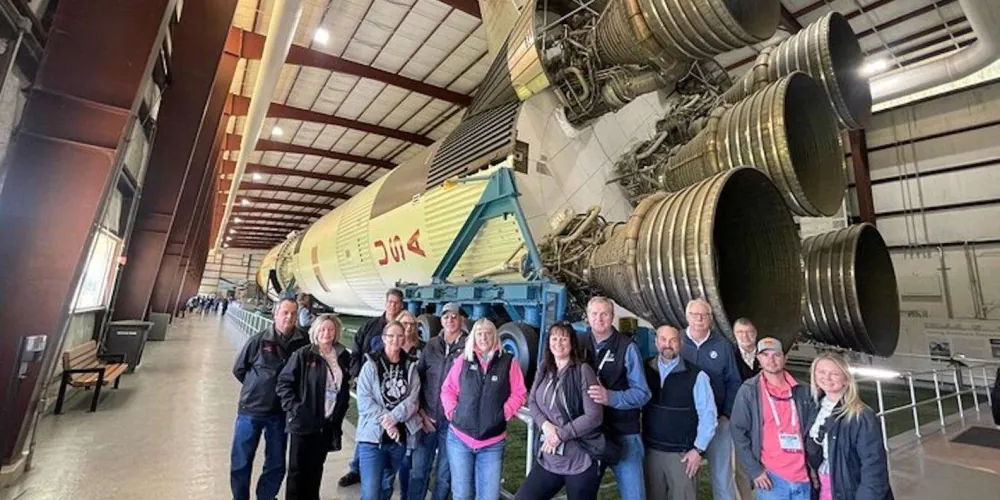
Three Saturn V rockets survive. Only one of them could have flown to the Moon.
That’s the one lying on its side in a climate-controlled building at Rocket Park, on the Johnson Space Center campus. Every stage was real flight hardware, built to fly, assigned to a mission — and then the missions were cancelled and the rocket never left the ground.
The other two survivors are mixtures: test articles, ground-test stages, boilerplate capsules. Houston’s is the genuine article, top to bottom, and it’s owned by the Smithsonian.
Here’s what you’re actually looking at.
Rocket Park is reached on the free NASA Tram Tour, included with general admission — see the tram tour guide for how boarding works. The ticket you need is the Space Center Houston Admission Ticket (from $29, 4.5★ · 3,846 reviews), the official timed-entry admission with free cancellation; our tickets guide covers every tier.
What Makes This One Different
NASA’s own wording is unambiguous: it is the only Saturn V “comprised of all flight-certified hardware capable of entering orbit around the Moon.” The Smithsonian’s object record puts it more plainly still — this is the only existing Saturn V with all flyable stages.
The three stages, and the missions that never happened
| Stage | Designation | Built for | Built by |
|---|---|---|---|
| First (S-IC) | S-IC-14 | The cancelled Apollo 19 | Boeing, at Michoud, New Orleans |
| Second (S-II) | S-II-15 | A Skylab backup vehicle | North American Aviation, Seal Beach |
| Third (S-IVB) | S-IVB-513 | A late, cancelled Apollo mission | Douglas Aircraft, Huntington Beach |
Topping the stack is a genuine Apollo Command and Service Module, built for a cancelled mission and never finished.
One clarification worth making: the vehicle number SA-513 launched Skylab, but Skylab flew with only two stages. The surplus third stage went to this display. So the rocket at Rocket Park is not “the Skylab rocket” — it’s assembled from surplus flight stages, one of which was built as part of that vehicle’s production run.
The Myth About Its Landmark Status
This gets reported wrongly almost everywhere, so it’s worth stating clearly.
Houston’s Saturn V is an ASME Historic Mechanical Engineering Landmark, designated in 1980 by the American Society of Mechanical Engineers. There’s a plaque.
It is not a National Historic Landmark.
The only Saturn V with National Historic Landmark status is the SA-500D in Huntsville, Alabama — which is a dynamic test vehicle that was never intended to fly at all.
So the one that could have gone to the Moon has the engineering award, and the one that was built to be shaken on a test stand has the national historic designation. Both are legitimate honours for different reasons, but they get conflated constantly.
The Three Surviving Saturn Vs, Compared
| Location | First stage | Second stage | Third stage | What it is |
|---|---|---|---|---|
| Houston (Rocket Park) | S-IC-14 — flight | S-II-15 — flight | S-IVB-513 — flight | All flight hardware, plus a real CSM |
| Kennedy Space Center | S-IC-T — ground test | S-II-14 — flight | S-IVB-514 — flight | Mixed. Painted in Apollo 11 markings |
| Huntsville, Alabama | S-IC-D — dynamic test | S-II-F/D — test | S-IVB-D — test | The SA-500D test vehicle. No flight stages |
Two things this table clears up:
Kennedy’s rocket wears Apollo 11 markings, which leads a lot of visitors to believe they’re looking at the vehicle that launched the first Moon landing. They aren’t — the real Apollo 11 launch vehicle was expended in 1969. Its first stage is a ground test article.
Huntsville has two Saturn Vs, which causes endless confusion. The real one — SA-500D — is indoors and horizontal. The one standing vertically outdoors, visible from the highway and in every photograph, is a full-scale replica.
There’s also a lone first stage, S-IC-15, on display at the INFINITY Science Center in Mississippi, moved there from Michoud in 2016. It’s a single stage, not a complete rocket.
Other Experiences Worth Pairing With Your Visit
Rocket Park sits on the working Johnson Space Center campus, so the tram is the only way in — which makes how you arrive at Space Center Houston the decision that actually shapes the day. A round-trip shuttle from downtown Houston (from $67, 4.8★ · 301 reviews) bundles admission with transport and skips the parking and the drive; a NASA-expert-guided visit (from $96, 4.7★ · 62 reviews) puts someone alongside you at the Saturn V and handles the tram queue; and if the restored Historic Mission Control is on your list, the Mission Control tram bundle (from $100, 4.7★ · 169 reviews) reserves those separate tickets in the same booking. Combo tickets also pair NASA with a downtown Houston city tour (from $98, 4.3★ · 522 reviews) or the Houston tunnel system (from $118, 4.9★ · 69 reviews), and Kemah Boardwalk and Galveston are both short hops further down the coast.
How It Was Nearly Lost
From 1977, this rocket sat outdoors on steel cradles in the Houston climate. That went about as well as you’d expect.
The Smithsonian documented the damage: external surfaces breaking down, corrosion working through internal and external structures, mould and plant growth signalling standing moisture and poor drainage. And — memorably — small animals had moved in, responsible for acidic debris and further damage.
The conservators recorded widespread paint failure, moisture infiltration, structural failures, and severe corrosion across the rocket’s complicated mix of metal alloys, plus degradation of its foam, cork, plastic and fibreglass components.
The rescue
The Smithsonian began fundraising in 1999. Conservation Solutions Inc. took on the work, treating it as a formal historic preservation project rather than a repaint.
What they did:
- High-pressure water-jet cleaning at over 25,000 psi
- Chemical gel stripping for the fragile materials
- Corrosion treatment and in-kind metal repair
- Restoration of the original markings — down to the smallest decal
- Photographic documentation of every square inch
What it cost: around $2.5 million for the rocket itself. Roughly half came from a Save America’s Treasures matching grant — about $1.25 million — with the balance from Boeing, Lockheed Martin, the Houston Endowment, Halliburton and others.
(You’ll see a $5 million figure quoted in some coverage. That appears to be a broader project total including the building and site works. The $2.5 million rocket conservation figure is the better-documented one.)
The Smithsonian’s curator described the result as the best surviving example of Saturn V hardware anywhere.
The building
Rather than move the rocket, the conservators built a climate-controlled structure around it — temperature and humidity managed, and genuinely air-conditioned, which matters more than it sounds in a Houston August.
It opened on 20 July 2007: thirty-eight years to the day after Apollo 11 landed. Astronauts John Young, Alan Bean, Walt Cunningham and Joe Kerwin attended, alongside JSC director Mike Coats.
One detail worth knowing: the building was explicitly designed as temporary, intended to last around ten years until a permanent home could be funded. It’s now well past that. Visitors sometimes describe it as looking like a shack from outside — that’s why.
The Rocket Itself
Scale
- Height: 363 feet fully stacked — taller than the Statue of Liberty, about 36 storeys
- Diameter: 33 feet across the first and second stages
- Weight: roughly 6.2 million pounds fuelled — Space Center Houston compares it to about 39 space shuttle orbiters
- Thrust at liftoff: around 7.5 million pounds
Stage by stage
First stage (S-IC). Five Rocketdyne F-1 engines burning kerosene and liquid oxygen. Fired for about 2 minutes 45 seconds, lifting the vehicle to roughly 42 miles and 6,000 mph, then fell into the Atlantic.
Second stage (S-II). Five J-2 engines burning liquid hydrogen and liquid oxygen. Burned for about nine minutes, carrying the stack nearly to orbit, then burned up on re-entry.
Third stage (S-IVB). A single restartable J-2. Fired once to reach parking orbit, then re-lit for about five minutes to send the spacecraft toward the Moon. Some spent third stages were then deliberately crashed into the lunar surface so seismometers left by earlier crews could measure the moonquakes.
The F-1 engine
Still the most powerful single-chamber liquid-fuel rocket engine ever flown.
- 1.5 million pounds of thrust from each engine
- About 18.5 feet tall, weighing around 18,500 pounds
- The five together burned roughly 15 tons of propellant per second
- Flight F-1s were 100% reliable in service
There’s a standalone F-1 on display outside, which is worth stopping at — it conveys the engineering better than the assembled rocket does, because you can actually take it in.
Reliability
Thirteen Saturn Vs launched between November 1967 and May 1973. None lost its payload. The only blemish was Apollo 6, an uncrewed test flight that suffered severe pogo vibration and engine shutdowns, and is generally logged as a partial failure.
It launched 26 astronauts, put six crews on the Moon, and lofted Skylab on its final flight.
Against modern rockets
| Vehicle | Liftoff thrust |
|---|---|
| Falcon Heavy | ~5.1 million lb |
| Saturn V | ~7.6 million lb |
| SLS Block 1 | ~8.8 million lb |
| Starship / Super Heavy | 16 million lb+ |
Thrust isn’t the whole story, though. The Saturn V could send roughly 43,500–48,600 kg toward the Moon. SLS Block 1 manages about 27 tonnes to trans-lunar injection — meaningfully less than a rocket designed in the early 1960s.
That comparison tends to stop people in their tracks, and it should.
The Rest of Rocket Park
The Saturn V dominates, but don’t walk past the rest.
Little Joe II
A single-stage solid-fuel rocket built by General Dynamics Convair, used at White Sands between 1963 and 1966 to test the Apollo launch escape system — the tower that would have pulled a crew clear of a failing rocket. It’s displayed on its launcher, topped with the Apollo boilerplate capsule BP-22 and escape tower.
Unglamorous, and one of the reasons Apollo crews had a way out.
Mercury-Redstone
Derived from the Army’s Redstone ballistic missile, this was America’s first crewed launch vehicle. It flew six suborbital Mercury missions in 1960–61, including Alan Shepard’s Freedom 7.
Visitors are consistently surprised by how small it is — which is exactly the point, standing a few hundred feet from a Saturn V.
The engine displays
Standalone F-1, J-2 and H-1 engines are displayed outside with interpretive markers. The H-1 powered the first stage of the Saturn I and IB — the Saturn V’s smaller predecessors.
The Apollo 13 statue
The newest addition, and the one people photograph most after the rocket itself.
Seven feet tall and around 1,400 pounds of gold bronze, it shows Jim Lovell, Jack Swigert and Fred Haise stepping off the recovery helicopter onto the deck of the USS Iwo Jima on 17 April 1970 — the moment the crisis ended.
It was sculpted by brothers George and Mark Lundeen with artist Joey Bainer, funded by The Grainger Foundation, and conceived by documentary filmmaker Steven C. Barber, who raised the money. A photorealistic mural of the Navy Sea King helicopter by Houston designer Blake Dumesnil forms the backdrop.
It debuted in February 2021, with a dedication that April. The same team created “The Eagle Has Landed,” the Apollo 11 statue at Kennedy Space Center, in 2019.
Who Was George Abbey?
The park was formally renamed George W.S. Abbey Rocket Park on 10 December 2021.
Abbey was one of NASA’s most consequential figures of the late twentieth century, and one of the least publicly known. He ran flight operations, led the selection committee for the first Space Shuttle astronaut class — the group nicknamed the Thirty-Five New Guys, which included NASA’s first women and first Black astronauts — and served as director of Johnson Space Center from January 1996 to February 2001.
In 1970 he received the Presidential Medal of Freedom along with the Mission Operations Team for the safe return of Apollo 13. He also founded the Longhorn Project on the pastureland beside the park.
He died on 24 March 2024.
Naming the park after him, with the Apollo 13 statue standing in it, has a certain symmetry.
Visiting
How you get there: the free NASA Tram Tour. Rocket Park is the simplest route — no advance booking, just join the queue. Details in the tram tour guide, and boarding-pass timing in our hours and parking guide.
How long you get: typically 25–35 minutes at the stop.
Is it comfortable? Yes. The Saturn V building is air-conditioned, which in a Texas summer makes it one of the more pleasant stops of the day.
What it’s like inside: the rocket lies horizontally on cradles and you walk its full length. Posters and banners alongside each stage explain what that section did. The lighting is functional rather than dramatic.
Accessibility: ground level, paved walkway, wheelchair accessible. The tram itself has ramps. That makes it a markedly easier stop than Independence Plaza, where the access tower’s elevators have been out of service.
Photography
Harder than you’d think. The building is close-fitting, so getting all 363 feet into one frame is essentially impossible — which is itself a useful illustration of the scale. Shoot along the length rather than trying to capture the whole thing, and use the engine bells for foreground.
What visitors say
The good: near-universal awe at the scale. Photographs genuinely don’t prepare people for it.
The less good: the building is plain and warehouse-like from outside, some interpretive material feels dated, and a few visitors report waits for the return tram.
None of the complaints are about the rocket.
How the Saturn V Came to Exist
Designed under Wernher von Braun, with Arthur Rudolph, at NASA’s Marshall Space Flight Center in Huntsville.
The stages were built across the country by different contractors — Boeing at Michoud in New Orleans, North American Aviation at Seal Beach in California, Douglas Aircraft at Huntington Beach, IBM building the instrument unit in Huntsville — and they were too large to move by road or rail. Most travelled by barge, some through the Panama Canal. The lighter third stages could fly aboard the bulbous Super Guppy aircraft.
The stages generally met for the first time in the Vehicle Assembly Building at Kennedy.
Why Apollo 18, 19 and 20 were cancelled
Apollo 20 went first, on 4 January 1970, so its Saturn V could launch the Skylab space station instead.
Apollo 18 and 19 followed on 2 September 1970, casualties of congressional cuts to NASA’s budget — and of a post-Apollo 13 reluctance to risk more crews for diminishing political return.
Congress had authorised only fifteen flight Saturn Vs. Production ended with SA-515. The surplus hardware became museum pieces — Houston, Kennedy, and eventually the INFINITY Science Center — or was scrapped.
Which is why the rocket at Rocket Park exists at all. It’s a mission that didn’t happen, preserved in aluminium.
The launches that did happen
- Apollo 4, 9 November 1967 — first flight, uncrewed
- Apollo 8, December 1968 — first humans beyond Earth orbit
- Apollo 11, launched 16 July 1969 — first Moon landing
- Every lunar mission through Apollo 17, December 1972
- Skylab, 14 May 1973 — the final Saturn V launch
Plan your visit. Rocket Park comes free with admission via the tram — get your boarding pass early.
Frequently Asked Questions
Is the Saturn V at Space Center Houston real?
Yes, and it’s the most authentic of the three surviving Saturn Vs. All three stages are genuine flight hardware — S-IC-14, S-II-15 and S-IVB-513 — built to fly on missions that were subsequently cancelled. NASA describes it as the only Saturn V comprised entirely of flight-certified hardware, and the Smithsonian, which owns it, calls it the only existing Saturn V with all flyable stages.
Where are the three Saturn V rockets?
At Johnson Space Center in Houston, the Kennedy Space Center Visitor Complex in Florida, and the U.S. Space & Rocket Center in Huntsville, Alabama. Only Houston’s is made entirely of flight hardware. Kennedy’s combines a ground-test first stage with flight upper stages, and Huntsville’s is the SA-500D dynamic test vehicle, which was never built to fly. Huntsville also displays a separate full-scale replica outdoors, which is frequently mistaken for the real one.
Which missions was the Houston Saturn V built for?
Its first stage was built for the cancelled Apollo 19, its second stage was a Skylab backup, and its third stage was built for a late Apollo mission that was also cancelled. The Apollo Command and Service Module on top was built for a cancelled mission and never completed. Descriptions of it as “built for Apollo 18, 19 and 20” are approximations.
How tall is the Saturn V?
363 feet fully stacked — taller than the Statue of Liberty, roughly 36 storeys. It’s 33 feet in diameter and weighed around 6.2 million pounds fully fuelled, generating about 7.5 million pounds of thrust at liftoff.
Is the Saturn V building air conditioned?
Yes. The climate-controlled building was built around the rocket during its 2000s conservation to protect it from Houston’s humidity, which had caused severe corrosion during nearly thirty years of outdoor display. It’s one of the more comfortable stops on the tram tour in summer.
Was the Saturn V more powerful than modern rockets?
Not in raw thrust — SLS Block 1 produces about 15% more, and SpaceX’s Starship far more. But the Saturn V could send roughly 43,500–48,600 kg toward the Moon, compared with about 27 tonnes for SLS Block 1, so in terms of lunar payload capability it remains extraordinarily capable for a design from the early 1960s.
How do you get to Rocket Park?
Rocket Park sits on the Johnson Space Center campus and is reached by the free NASA Tram Tour departing from Space Center Houston, included with general admission. The Rocket Park route requires no advance booking — you simply join the tram queue.
Why is it called George W.S. Abbey Rocket Park?
It was renamed in December 2021 for George Abbey, a highly influential NASA figure who directed flight operations, led the selection of the first Space Shuttle astronaut class, and served as director of Johnson Space Center from 1996 to 2001. He received the Presidential Medal of Freedom in 1970 alongside the Mission Operations Team for the safe return of Apollo 13. He died in 2024.
See NASA's Home of Human Spaceflight
Join the visitors who rate Space Center Houston a highlight of their trip — the Saturn V rocket, Historic Mission Control, the world's largest public moon-rock collection, and Independence Plaza. Reserve timed admission with free cancellation.
Check Availability & Book