The NASA Tram Tour: What You Actually See at Every Stop
What the NASA Tram Tour is really like — every route explained, what you see at each stop, how the boarding pass system works, and how to avoid the queue.
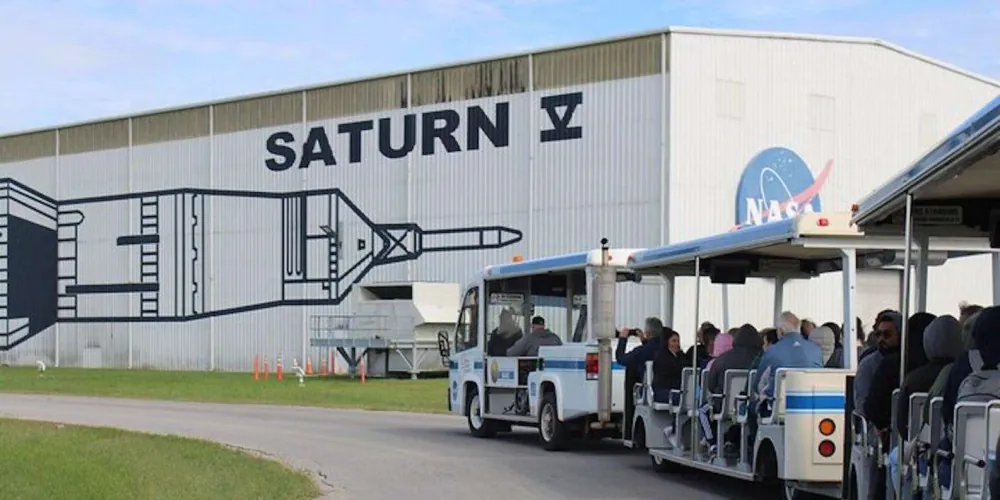
The tram is the reason to come. Everything else at Space Center Houston is a museum — very good, but a museum. The tram crosses the road onto the working Johnson Space Center campus, and it’s the only way the public gets in.
What nobody tells you is that the tram is also the part of the day most likely to go wrong. Not because the tours disappoint, but because the boarding system is genuinely confusing, the queues on a busy Saturday can run to ninety minutes, and the last tram leaves two hours before closing — which catches out people who spend the morning in the galleries.
This is what each route actually shows you, and how to make sure you get on one.
If Historic Mission Control is on your list, sort it before anything else — it’s the one tram that cannot be added on the day. The bundle below pairs general admission with pre-reserved Mission Control tram tickets:
What the Tram Itself Is Like
These are open-air, tractor-drawn trams with bench seating and a roof but no sides. You’re exposed to heat, wind, and rain. A crew member narrates over a PA as you drive through campus.
The practical rules:
- Tours run 60–90 minutes depending on route
- The last tram departs two hours before closing — around 3pm on a standard 10am–5pm day, later during extended summer hours
- No strollers on the tram. There’s stroller parking by the tram queue
- No food. Closed-lid drinks only
- Very limited restroom access during the tour — go before you board
- English-only narration
- All trams have wheelchair lifts — ask a crew member at boarding
Photography and Audio: Two Things to Know Before You Board
On photography: phones and small cameras are fine. But this is a federal facility, and crew will point out restricted areas where cameras must stay down. Tripods, gimbals, selfie sticks, action cameras, drones, and lenses longer than six inches are all prohibited.
One honest warning about the audio. The tram PA is the single most-criticised element of the experience. Between engine noise, open sides, and ambient campus activity, visitors frequently report missing most of the narration. Sit as close to the front of your car as you can.
Worth Adding to Your Itinerary
The NASA Tram Tour is the centrepiece of a Space Center Houston visit, but there are ways to make the day even more complete. If you’re coming from downtown without a car, a transport-included ticket bundles your admission and shuttle in one booking, so you arrive ready to grab that first boarding pass. Want expert commentary as you move through the exhibits and navigate the tram strategy? A NASA-expert-guided tour handles all of that for you.
The Four Routes
Three routes are free with general admission; one costs extra. Each uses a different boarding method, which is the source of most visitor confusion.
| Route | Cost | How to board | Get off the tram? |
|---|---|---|---|
| Rocket Park | Free | Just join the queue | Yes — self-guided walk |
| Astronaut Training Facility | Free | Timed pass — Guest Services or app | Yes — elevated walkway |
| NASA Campus | Free | Timed pass — Guest Services or app | Mostly no |
| Historic Mission Control | ~$15 add-on | Pre-book online | Yes — viewing gallery |
All routes are “subject to availability,” and NASA can suspend any of them without notice.
Rocket Park: Standing Under a Saturn V
The simplest route — no boarding pass needed. Just join the tram queue. You get off and explore independently.
The centrepiece is the Saturn V, lying horizontally at its full 363 feet inside a dedicated, climate-controlled building. You walk its entire length beneath the three stages, with interpretive panels explaining each.
Why this particular rocket matters
There are only three Saturn Vs left in the world. This is the only one made entirely of flight-certified hardware — every stage was built to fly and would have flown, had the programme not ended.
Its stages come from missions that never happened:
- First stage (S-IC-14) — built for the cancelled Apollo 19
- Second stage (S-II-15) — a Skylab backup vehicle
- Third stage (S-IVB-513) — built for the cancelled Apollo 18
The Smithsonian owns it; it’s been on loan to Johnson Space Center since 1977. Houston’s humidity had badly corroded it before a two-year restoration concluded in 2007, after which the protective building was added.
What each stage did in flight: the first stage fired its five F-1 engines for around 2 minutes 47 seconds before dropping into the ocean; the second burned for about 9 minutes to reach space; the third fired twice — a short burn to reach parking orbit, then a five-minute burn to send the spacecraft toward the Moon.
Elsewhere in the park: Little Joe II, Mercury-Redstone and Gemini-Titan rockets, F-1 and J-2 engine displays, and the Apollo 13 bronze statue — seven feet tall and roughly 1,400 pounds — recreating the moment Lovell, Swigert and Haise stepped off the recovery helicopter in April 1970.
What impresses: the scale. Visitors consistently say photographs don’t prepare you. More detail: Rocket Park and the Saturn V.
Astronaut Training Facility: Watching People Train for Space
This route goes to Building 9, the Space Vehicle Mockup Facility, where every NASA astronaut since 1980 has trained. A free timed boarding pass is required — this is the most popular route and the one to collect first.
You don’t walk the floor. You walk an elevated catwalk above it and look down — so visitors never interact with the working team below.
What’s visible depends on the day, but typically includes:
- Full-scale ISS module mockups — 1:1 scale, each roughly the size of a school bus
- A medium-fidelity Orion capsule mockup
- Robotic hardware — the Robonaut and Valkyrie humanoid robots, plus lunar and Mars rover prototypes
Will you see astronauts training? Sometimes — but it’s not guaranteed. Building 9 is a real working facility, not a display. Whether people are actively training below depends entirely on that day’s schedule. That’s exactly what makes it worth seeing, and exactly why you can’t count on the timing.
This route usually includes a Rocket Park stop, so you get the Saturn V too. More: inside the astronaut training facility.
NASA Campus Tour: The Honest Assessment
A guided drive through the wider Johnson Space Center campus — training facilities, historic spacecraft, research buildings — with an option to hop off at Rocket Park. Free timed pass required.
This is the weakest of the four routes. There’s minimal disembarking. Most of it is narration from a moving tram, delivered over that unreliable PA. Think of it as a campus orientation drive rather than an experience. If Astronaut Training Facility passes are available, prioritise those. If those are gone and this is what’s left, take it rather than skipping the tram entirely.
Historic Mission Control: The One That Gives People Goosebumps
The only paid tram, and the emotional high point for most people who take it.
The tram goes to Building 30, the Christopher C. Kraft Jr. Mission Control Center. You’re seated in the original visitor gallery — the same theatre-style seats where families, press and dignitaries watched in 1969. The pop-out ashtrays are still in the seat backs. Through the glass is the restored Mission Operations Control Room. Then the presentation begins: the room darkens, the consoles and front wall screens light up, and you hear the real controller and astronaut audio from the Apollo 11 landing as the mission clocks run down. It lasts only a few minutes. People describe instant goosebumps.
What was restored, and how far they went
The restoration was led by NASA historic preservation officer Sandra Tetley, completed for the Apollo 11 fiftieth anniversary with a ribbon-cutting on 28 June 2019. Cost: roughly $5 million, funded by around $3.1 million from the city of Webster, Texas, approximately $525,000 from a Kickstarter campaign, and roughly $1 million from JSC itself.
The target was the room’s exact appearance on 20 July 1969. Consoles were shipped to the Cosmosphere in Hutchinson, Kansas to be restored and reanimated. Carpeting, ceiling tiles, light fixtures and even the Steelcase chair fabric were re-created or custom-matched from archives. Retired flight controllers donated period ashtrays, clipboards and pens. The room had been designated a National Historic Landmark in 1985 but left to decay — by 2015 the National Park Service had listed it as threatened.
What was run from this room: nine Gemini missions, every Apollo lunar mission including Apollo 11 and Apollo 13, and 21 space shuttle missions, until it was decommissioned in 1992.
Booking it
- Around $15 per person as an add-on to general admission (members get 50% off)
- Must be pre-booked online — cannot be added on the day
- Sells out days ahead on weekends, holidays and school breaks; two weeks ahead is the safe window
- No bags permitted inside, to protect the original furnishings
- Non-refundable; NASA can cancel for weather
If you’d rather have it pre-reserved in one booking: NASA Historic Mission Control Tram Tour + General Admission — from $100, 4.7★ · 169 reviews — or see our full breakdown of that bundle.
How the Boarding System Actually Works
This is where visits go wrong most often.
Two ways to get a free boarding pass
1. The Space Center Houston app — look for “Join the Virtual Tram Line.” Select your tour and group size, and reserve a slot.
Two things nobody warns you about:
- It’s location-gated. You must be physically on-site for it to work. You cannot join the queue from your hotel or on the drive over.
- It’s buggy. Visitors report it losing their place in the queue — restarting the app usually restores it — and the countdown clock often fails to refresh. It only ever offers the next available slot at the moment you press the button.
2. The Guest Services desk, near the entrance. Staff reserve a timed pass for you. If the app is misbehaving, go here instead.
Which routes need what
| Route | What you need |
|---|---|
| Rocket Park | No pass — just queue |
| Astronaut Training Facility | Timed pass (app or Guest Services) |
| NASA Campus | Timed pass (app or Guest Services) |
| Historic Mission Control | Pre-booked online; not through the virtual line |
Realistic wait times
| When | What to expect |
|---|---|
| Quiet weekday morning | Minimal; routes may run combined |
| Busy weekend, Rocket Park | Around 90 minutes |
| Busy weekend, free passes | Often gone by ~12:30pm |
| Peak day, worst case | Reports of two hours inside plus one outside |
All free passes are first-come, first-served. There is no way to reserve them before arriving.
The quiet-day bonus
On low-traffic days the centre sometimes runs a single combined tram covering the training facility and Rocket Park in one loop of just under two hours. You get everything without choosing. This is a strong argument for visiting midweek in the off-season.
Weather and Cancellations
The trams are open-air, which has real consequences.
Rain and lightning stop the tour. Visitors regularly report trams shut down on wet days while the indoor museum operates normally. Since the museum is roughly 90% indoors, a rainy day isn’t a lost day — but it may be a tram-free one.
Buildings can close without notice. These are working government facilities. Routes get changed at short notice. On refunds: the free routes carry no financial risk. For the paid Mission Control add-on, NASA can cancel for weather. Booked direct, that’s generally a reschedule or refund; third-party packagers often treat the NASA portion as non-refundable. Book direct and confirm the policy at checkout.
On heat: the outdoor queue in a Texas summer is genuinely punishing. The waiting area is only partly covered, and the open trams warm through the afternoon. Bring water, wear a hat, and aim for a morning slot.
The Mistakes People Make
Exploring the galleries first. The single biggest error. By the time visitors finish Starship Gallery, the good tram passes are gone. Reserve first, explore second.
Not knowing the app is location-gated. People try to join the virtual line on the drive over and assume it’s broken.
Missing the last-tram cutoff. Two hours before closing, every day. On a 10am–5pm day that’s 3pm — much earlier than most people assume.
Bringing a bag to Mission Control. Bags aren’t allowed inside. Consolidate before you board.
Underestimating the heat. Queuing outdoors in July in Houston is not a neutral experience.
Getting the Best Out of It
The plan that works:
- Pre-book Historic Mission Control when you buy admission, and take the earliest entry slot available
- Arrive at opening
- Before anything else — open the app on-site or go straight to Guest Services and lock in an Astronaut Training Facility pass
- Ride the trams in the morning while it’s cooler and queues are shorter
- Do galleries, films and live shows around your tram times
When to go: weekday mornings in the off-season — February, late September through October, early December. Avoid mid-March spring break, June through August, and holidays. If you must visit then, be at the door when it opens.
What to bring: a closed-lid water bottle, hat, sunscreen, comfortable shoes. Leave large bags, tripods and long lenses behind. Use the restroom before boarding.
If storms are forecast: do the tram first thing. Afternoon cancellations are common, and the museum is a perfectly good fallback.
More on when to go: best time to visit Space Center Houston. For a full breakdown of every tour option — free trams, premium experiences, and day trips from downtown — see our Space Center Houston tours guide.
Frequently Asked Questions
Is the NASA tram tour included with admission?
Three of the four routes are included free with general admission: Rocket Park, the Astronaut Training Facility, and the NASA Campus tour. The fourth, to Historic Mission Control, is a paid add-on of around $15 that must be booked online in advance alongside your ticket.
How long is the NASA tram tour?
Each route runs 60–90 minutes, plus queuing time that can reach 90 minutes or more on busy weekend afternoons. On quiet days the centre sometimes runs a single combined route covering all three free destinations in just under two hours.
Do you need to book the NASA tram tour in advance?
The three free routes cannot be booked in advance. You reserve a timed boarding pass on the day, either through the Space Center Houston app’s virtual tram line — which only works once you’re physically on-site — or at the Guest Services desk. The paid Historic Mission Control tram must be booked online in advance and regularly sells out.
What time is the last NASA tram tour?
The last tram departs two hours before the centre closes. On a standard 10am–5pm day that’s around 3pm; on extended summer and weekend hours it runs later. This catches out visitors who spend the morning in the galleries — plan accordingly.
What do you see on the NASA tram tour?
Depending on the route: the Saturn V rocket at Rocket Park — one of only three left, and the only one built entirely of flight-certified hardware — plus the Apollo 13 statue and earlier rockets; the astronaut training floor in Building 9, viewed from an elevated walkway; a guided drive through the working Johnson Space Center campus; and, on the paid route, the restored Apollo-era Mission Control room with an audio-visual re-enactment of the Apollo 11 landing.
Which NASA tram tour is best at Space Center Houston?
The Astronaut Training Facility tram is the best of the free routes — it shows you active NASA hardware and typically includes a Rocket Park stop, so you see the Saturn V too. The paid Historic Mission Control tram is the single most memorable experience on the campus if you’re willing to pre-book and pay the add-on.
Can you see astronauts training on the tram tour?
Sometimes, but it isn’t guaranteed. The Astronaut Training Facility route passes above Building 9’s working training floor on an elevated walkway. Whether astronauts or engineers are actively working below depends entirely on that day’s schedule.
Is the NASA tram tour wheelchair accessible?
Yes. All trams are equipped with lifts — ask a crew member at boarding. The buildings on the routes have elevators, though wheelchair users may be seated on the engine car, which is noisier. Note that Historic Mission Control involves stairs, with an elevator available.
Does the tram tour run in the rain?
Not reliably. The trams are open-air and are frequently suspended for rain or lightning while the indoor museum stays open. Plan to ride the tram first thing if storms are forecast.
See NASA's Home of Human Spaceflight
Join the visitors who rate Space Center Houston a highlight of their trip — the Saturn V rocket, Historic Mission Control, the world's largest public moon-rock collection, and Independence Plaza. Reserve timed admission with free cancellation.
Check Availability & Book