NASA Spacesuits & the Astronaut Gallery: Sixty Years of Keeping People Alive
A Moon-dust-covered Apollo 12 suit, sixty years of engineering, and the seamstresses who hand-sewed the suits that walked on the Moon.
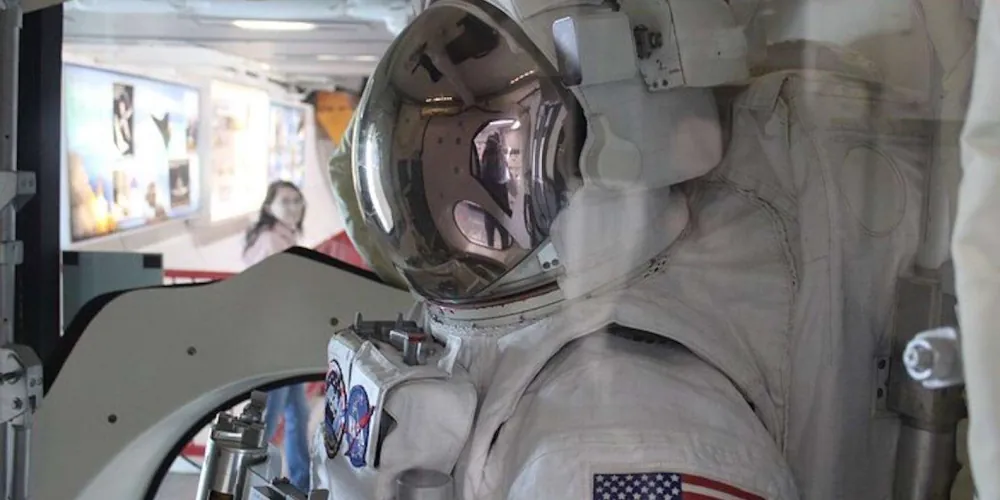
There’s a spacesuit in this gallery with Moon dust still on it.
It belonged to Pete Conrad, who wore it on the surface during Apollo 12 in November 1969. Space Center Houston states it is one of only two spacesuits worn on the Moon displayed anywhere outside the Smithsonian. Look closely at the legs and boots and you can see the grey powder still embedded in the fabric — regolith that has been there since it was picked up off another world.
That’s the reason to slow down here. The Astronaut Gallery looks like a room of mannequins until you understand that each suit is a solved engineering problem, and that people died learning what the problems were.
Included with general admission — no separate ticket, and allow 20–40 minutes. The gallery is inside the main building, so the Space Center Houston Admission Ticket (from $29, 4.5★ · 3,846 reviews) is all you need; it’s the official timed-entry ticket with free cancellation. Our tickets guide breaks down every tier and price.
What’s Actually on Display
Space Center Houston describes the collection as one of the world’s most comprehensive collections of astronaut apparel and spacesuits — and unusually, most of what’s here is genuine flown or flight-qualified hardware rather than replicas.
The Headline Suits
| Suit | Why it matters |
|---|---|
| Pete Conrad’s Apollo 12 lunar suit | Worn on the Moon. Visible lunar dust. On loan from the Smithsonian |
| Michael Collins’ Apollo 11 biological isolation garment | Worn during post-splashdown quarantine |
| Deke Slayton’s Apollo-Soyuz A7LB | The later Apollo suit variant, on loan from the Smithsonian |
| John Young’s STS-1 escape suit | From the first Space Shuttle flight, 1981 |
| Kathryn Sullivan’s Shuttle EMU | First American woman to walk in space |
| Wally Schirra’s Apollo 7 in-flight coveralls | |
| Paul Weitz’s Skylab liquid cooling garment | The layer worn under a pressure suit |
| Judy Resnik’s T-38 flight suit | The last NASA garment she wore before Challenger |
| Mark III hard suit prototype | A technology demonstrator that never flew |
A Crew Portrait Wall recognises every NASA astronaut who has flown.
⚠️ Read the labels. Not everything here is a flown personal artifact, and the museum is honest about it. The Sally Ride coveralls, for instance, are described as “similar to” ones she wore — representative apparel rather than her own garment. Conrad’s and Slayton’s suits are the real thing. Some other items are illustrative. The labels tell you which is which, and it’s worth reading them.
Displays rotate. Smithsonian loans move in and out, and Space Center Houston says there’s always something new. Don’t travel specifically to see one suit without checking first.
Why the Suits Got Harder to Build
Each generation solved a problem the previous one couldn’t. That’s the story the gallery tells if you walk it in order.
Mercury (1961–63): Survive a Leak
The Mercury suit wasn’t designed for space at all. It was a modified Navy Mark IV high-altitude pressure suit, designed by Russell Colley — the same engineer who built Wiley Post’s pioneering pressure suit in the 1930s.
At 22 pounds it was the lightest pressure suit of its era, using elastic cording to stop it ballooning when pressurised.
It was never meant for spacewalks. It was a backup in case the capsule lost pressure. Astronauts wore it sitting down, and that was the extent of the design brief.
Gemini (1965–66): Learn to Leave
Gemini’s suits, built by the David Clark Company, replaced fabric joints with a pressure bladder wrapped in a woven link-net restraint layer — which kept the suit flexible under pressure rather than rigid.
On 3 June 1965, Ed White made the first American spacewalk from Gemini 4, tethered by an umbilical.
Then came the lesson.
Gemini 9, June 1966. Gene Cernan attempted to test an Air Force manoeuvring unit. With no handholds and no footholds, every movement sent him tumbling. He later described the pressurised suit as having the flexibility of a rusty suit of armour.
His heart rate reached around 195 beats per minute. The suit’s cooling system was overwhelmed. His visor fogged over so completely that he had to rub his nose against the inside of it to see anything at all.
The test was abandoned. He very nearly didn’t get back in.
What NASA took from it became the permanent doctrine of spacewalking: body restraints, neutral buoyancy training in water, careful metabolic pacing, better cooling. Buzz Aldrin’s successful Gemini 12 spacewalk happened because Cernan nearly died on Gemini 9.
Apollo A7L (1968–72): A One-Person Spacecraft
The lunar suit was built by ILC Dover — and yes, the story about the bra company is true. But it’s usually told wrong.
The accurate version: the parent firm was the International Latex Corporation, which made Playtex girdles and bras through its Playtex Division. The spacesuit was built by a different arm of the same company — the Government and Industrial Division in Delaware, which later became ILC Dover.
Same corporation. Different divisions.
And that soft-goods heritage is exactly why they won. In the 1965 competition, the favourite was Hamilton Standard, whose engineering-led rigid prototype reportedly looked like a robot. ILC’s insight was that soft goods could contain pressure while preserving mobility — that a suit which couldn’t bend was useless no matter how well engineered.
The human detail is real too. Skilled seamstresses — Hazel Fellows among them, documented by the Smithsonian — hand-sewed the suits on modified Singer machines to a tolerance of one sixty-fourth of an inch, because no machine could be trusted with the only thing standing between a person and vacuum.
What the A7L was:
- 21 layers, from a neoprene-coated nylon pressure bladder outward
- Teflon-coated Beta cloth for fire protection — redesigned after the Apollo 1 fire, which is why it’s the A7L rather than the earlier A5L and A6L
- Aluminised Mylar insulation
- Chromel-R steel fabric against micrometeoroids
- A liquid cooling garment underneath, circulating chilled water through tubing
- The Portable Life Support System backpack: oxygen, CO₂ scrubbing, power, cooling
The full lunar ensemble weighed about 200 pounds on Earth — around 33 pounds in lunar gravity.
Neil Armstrong’s was model A7L, serial 056, and cost roughly $100,000 at the time. Over $670,000 today.
The A7LB came later, for Apollo 15, 16 and 17, adding waist and neck joints so astronauts could sit in the Lunar Rover and work longer shifts. That’s the variant Slayton’s suit represents.
The Shuttle EMU (1983–present): The Suit That Never Retired
The Extravehicular Mobility Unit was a different philosophy: modular and reusable rather than custom-tailored.
Built around a rigid fibreglass Hard Upper Torso, with interchangeable arms, legs and gloves, it was designed to fit the 5th to 95th percentile of astronauts and be reused across missions. It pressurises to 4.3 psi of pure oxygen and weighs 250–300 pounds on Earth.
It was designed for a 15-year service life and about 25 spacewalks.
It blew past that deadline decades ago. As of 2025, only four EMUs remained aboard the ISS, drawn from an original production run of just 18 life-support units.
When the Age Started Showing
16 July 2013. During a spacewalk, ESA astronaut Luca Parmitano’s helmet filled with water — between one and one and a half litres of it, leaking from the suit’s cooling system.
In microgravity, water doesn’t fall. It clung to his face in a film. He couldn’t see, couldn’t hear properly, and was at genuine risk of drowning inside his own helmet. The spacewalk was aborted after 92 minutes and NASA classified it a high-visibility close call.
The cause was traced to a clogged water separator that spilled cooling water into the ventilation loop.
Similar problems forced NASA to suspend non-emergency spacewalks again in 2022, with more scrubbed spacewalks in 2024. NASA’s own Inspector General now refers to the fleet as a 50-year-old spacesuit design carrying growing safety risk.
Other Experiences Worth Pairing With Your Visit
The Astronaut Gallery costs nothing extra, so the real question is how you reach Space Center Houston and how much of the day you hand over. A round-trip shuttle from downtown Houston (from $67, 4.8★ · 301 reviews) bundles admission with transport; a NASA-expert-guided visit (from $96, 4.7★ · 62 reviews) walks the indoor galleries with you, which helps when the labels alone won’t tell you why a suit matters. For the restored Historic Mission Control, the Mission Control tram bundle (from $100, 4.7★ · 169 reviews) reserves those tickets in the same booking, and the Houston CityPASS (from $72, 4.6★ · 265 reviews) folds NASA in with the Houston Zoo and the Museum District. Kemah Boardwalk is ten minutes down NASA Parkway; Galveston is under an hour south.
Untethered: the MMU
On 7 February 1984, Bruce McCandless flew the nitrogen-propelled Manned Manoeuvring Unit up to 300 feet from Challenger — the first untethered spacewalk, and one of the most reproduced photographs in the history of spaceflight: a human being alone against black space with nothing connecting him to anything.
His line afterwards: “It may have been one small step for Neil, but it’s a heck of a big leap for me.”
The MMU flew on only three missions, all in 1984. After Challenger, its safety profile and the proven capability of the shuttle’s robotic arm led NASA to shelve it.
How Spacesuits Actually Work
A spacesuit has to do all of this at once:
- Maintain pressure, so bodily fluids don’t boil
- Supply oxygen and remove carbon dioxide
- Manage temperature swings from around −150°C to +120°C
- Stop micrometeoroids and some radiation
- Allow the wearer to move and work
- Handle communications, water and waste
It isn’t clothing. It’s a person-shaped spacecraft.
The Central Problem: Pressure Versus Movement
Pressurise a suit and it stiffens into a balloon. Every generation has attacked this differently — elastic cording on Mercury, link-net restraint on Gemini, moulded rubber convolute joints on Apollo, constant-volume bellows and bearings on the EMU.
Suits run at low pressure precisely to stay mobile. But that creates a new problem.
Why Astronauts Have to Breathe Pure Oxygen First
Moving from a cabin at 14.7 psi to a suit at 4.3 psi risks decompression sickness — the bends, the same condition divers get.
So astronauts pre-breathe pure oxygen to flush nitrogen out of their tissues. On the Shuttle this meant a 12-hour protocol, or dropping cabin pressure to 10.2 psi to cut it to around 40 minutes. On the ISS it can run up to four hours.
Every spacewalk you’ve seen footage of was preceded by hours of someone sitting still, breathing oxygen, waiting.
Gloves Are Still the Hardest Part
As one Smithsonian curator has put it, gloves are the most difficult part of a suit to design — because humans need fine dexterity while working inside a pressurised bladder.
Astronauts have lost fingernails. Hand injuries and cramping are routine complaints, and they trace right back to Apollo. The EMU is on its sixth generation of gloves, with competitions still being run for better ones.
Sixty years of engineering, and hands remain unsolved.
The Suits Are Dying
The Apollo suits are deteriorating, and it can’t be reversed.
The Smithsonian found its reference collection of 88 Mercury, Gemini and Apollo suits in decline: rubber bladders gone brittle and crumbling, aluminised coatings flaking away, metal rings corroding. Curators keep them at around 60°F and 35% humidity to slow it down. That’s all that can be done.
Neil Armstrong’s suit went on a world tour after the mission, was displayed from 1976 to 2006, then withdrawn for stabilisation.
In 2015 the Smithsonian ran its first-ever Kickstarter — Reboot the Suit — to conserve and re-display it. It hit its $500,000 goal in five days and raised over $700,000, with a stretch goal added for Alan Shepard’s Mercury suit.
The conserved suit was unveiled on 16 July 2019, days before the fiftieth anniversary, near the 1903 Wright Flyer. Its first public appearance in thirteen years.
Which puts Conrad’s suit here in context: Moon-worn suits on public display are genuinely rare, and getting rarer.
What Comes Next: the Artemis Suits
This section changes fast. Verified July 2026.
NASA Gave Up Building Its Own
After more than a decade and over $420 million developing the xEMU exploration suit in-house without producing a flight-ready article, NASA changed approach in 2022. Under the xEVAS programme it now buys spacewalking as a commercial service, with contracts to Axiom Space and Collins Aerospace.
In June 2024, Collins withdrew — NASA and the company mutually agreed to remove its task orders, citing an inability to meet schedule.
That leaves Axiom as the sole provider. NASA’s Inspector General has repeatedly flagged the concentration risk.
The AxEMU
Axiom’s suit was unveiled as a prototype at Space Center Houston in March 2023. It’s a single architecture for both lunar and orbital use — the only difference is swapping walking boots for LEO boots.
The collaborators are unexpected: the outer layer designed with Prada, the visor with Oakley, communications with Nokia.
What it must do that Apollo’s suits couldn’t:
- Operate at the lunar south pole, where permanently shadowed craters drop below −230°C
- Support spacewalks of up to eight hours, repeatedly, over much longer surface stays
- Fit a far wider range of body sizes
- Let astronauts kneel and work properly, rather than the bunny-hopping of Apollo
- Survive lunar dust
Lunar Dust Is the Real Enemy
Apollo proved dust isn’t a nuisance — it’s a flight safety hazard.
Lunar regolith has never been weathered by wind or water, so every grain is jagged. It’s electrostatically clingy and abrasive. During Apollo it wore through boot layers, destroyed the vacuum seals on sample containers, clogged mechanisms, degraded thermal coatings, and caused what crews called lunar hay fever when tracked back inside.
Gene Cernan, who had already nearly died in a suit once, called dust probably one of our greatest inhibitors to a nominal operation on the Moon.
Modern toxicology shows lunar dust simulant damages human lung cells. Dust mitigation is now a formal NASA requirement.
Apollo tolerated it because surface time was measured in hours. Artemis can’t, because it will be measured in days.
The Schedule, Honestly
The official position: In February 2026 NASA redefined Artemis III as a crewed Earth-orbit test flight targeted for 2027, moving the first crewed landing to a 2028 mission. NASA Administrator Jared Isaacman said in April 2026 that he was confident astronauts would be wearing Axiom suits when NASA lands in 2028. Axiom says it’s on track for a 2027 demonstration, having logged over 950 hours of crewed pressurised testing.
The watchdog’s position: NASA’s Office of Inspector General reported in April 2026 that the development schedules — 3.4 years for the lunar suit — were less than half of the 8.7-year historical average from contract award to test flight. If Axiom hits that historical average, the report warned, demonstrations would not occur until 2031. It also noted the suit had exceeded NASA’s mass limits at preliminary design review, and that there is little to no schedule margin.
The 2031 figure is a benchmark, not a NASA schedule. But the gap between the contractor’s confidence and the auditor’s arithmetic is the honest state of play.
Visiting the Gallery
Where: inside the main museum building, alongside Starship Gallery, the ISS Gallery, Mission Mars and the Artemis exhibit. Not part of the tram tour, and not on the same side of the campus as the astronaut training facility you reach by tram.
How long: 20–40 minutes.
Cost: included with general admission.
Photography: permitted. The challenge is low, museum-grade case lighting behind glass — bring a fast lens or steady hands, since flash is unhelpful against glass anyway. No tripods, monopods, external lighting or drones.
Accessibility: the building is broadly accessible and Space Center Houston is a certified autism centre.
What visitors say: the authenticity is what lands — real Moon dust, and the human stories attached to Ride, Resnik and Slayton. The most common quiet disappointment is that it’s a fast stop compared with the flown spacecraft next door, and that some items are representative rather than flown.
Where it fits: pair it with Starship Gallery and read them together — the lunar samples are in the same room. The capsules show you where astronauts sat. The suits show you what kept them alive when they left.
Plan your visit. The Astronaut Gallery is included with admission and sits near the other indoor galleries — see hours and planning for opening times, parking and how long to allow.
Frequently Asked Questions
Are there real spacesuits at Space Center Houston?
Yes, and most are genuine flown or flight-qualified artifacts rather than replicas. The most significant is Pete Conrad’s Apollo 12 lunar surface suit — worn on the Moon in November 1969, with lunar dust still visible on it — which Space Center Houston states is one of only two Moon-worn suits displayed outside the Smithsonian. Some items are representative apparel, so it’s worth reading the labels.
Did a bra company really make the Apollo spacesuits?
Broadly yes, though it’s usually told imprecisely. The Apollo A7L was built by ILC Dover, whose parent company, International Latex Corporation, made Playtex girdles and bras through a separate division. The spacesuit work was done by the Government and Industrial Division. That soft-goods expertise is why ILC won the contract — its rival’s rigid prototype was better engineered but couldn’t bend.
How many layers does an Apollo spacesuit have?
Twenty-one. They run from a neoprene-coated nylon pressure bladder outward through Teflon-coated Beta cloth for fire protection, aluminised Mylar insulation, and Chromel-R steel fabric against micrometeoroids. A liquid cooling garment circulating chilled water was worn underneath, and the Portable Life Support System backpack supplied oxygen, CO₂ scrubbing, power and cooling.
Why do astronauts breathe pure oxygen before a spacewalk?
To avoid decompression sickness. Spacesuits run at low pressure — the EMU at 4.3 psi against a cabin at 14.7 psi — because higher pressure makes them too stiff to work in. Moving between those pressures risks the bends, so astronauts pre-breathe pure oxygen to purge nitrogen from their tissues. On the ISS this can take up to four hours.
How old are the spacesuits used on the ISS?
The Extravehicular Mobility Unit dates to the early 1980s and was designed for a 15-year service life and around 25 spacewalks. It is decades past that. Only four remained aboard the station as of 2025, from an original run of 18 life-support units, and NASA’s Inspector General describes it as a 50-year-old design with growing safety risk.
What happened to Luca Parmitano’s spacesuit?
During a spacewalk in July 2013, over a litre of water leaked from the cooling system into ESA astronaut Luca Parmitano’s helmet. In microgravity it clung to his face rather than draining, leaving him unable to see and at real risk of drowning. The spacewalk was aborted after 92 minutes and NASA classified it a high-visibility close call. The cause was a clogged water separator.
When will NASA have new spacesuits for the Moon?
Axiom Space is now the sole provider of Artemis lunar suits after Collins Aerospace withdrew in 2024. Axiom and NASA target a 2027 demonstration and a 2028 first landing. However, NASA’s Inspector General reported in April 2026 that the development schedule was less than half the historical average, and that at typical rates demonstrations might not occur until 2031.
Why is lunar dust a problem for spacesuits?
Because it has never been weathered by wind or water, lunar dust is jagged, abrasive and electrostatically clingy. During Apollo it wore through boot layers, destroyed sample container seals, clogged mechanisms and degraded thermal coatings, and crews suffered respiratory irritation from it. Modern research shows it damages human lung cells. Apollo tolerated it over hours; Artemis missions lasting days cannot.
See NASA's Home of Human Spaceflight
Join the visitors who rate Space Center Houston a highlight of their trip — the Saturn V rocket, Historic Mission Control, the world's largest public moon-rock collection, and Independence Plaza. Reserve timed admission with free cancellation.
Check Availability & Book