Moon to Mars: Artemis, Orion & What NASA Is Building Next
The Artemis exhibit, the flown Moonikin Campos, and where NASA's Moon programme stands after the 2026 restructuring.
📅 Programme status, as of August 2026
Much of what was published about Artemis before 2026 is now out of date. The programme was restructured in February 2026, and the mission numbers no longer mean what they used to.
- Artemis II has flown. Four astronauts went around the Moon and came home, 1–10 April 2026
- Artemis III is no longer the landing. It’s now a crewed Earth-orbit docking test, targeted for 2027
- The first Moon landing since Apollo is Artemis IV, targeted for 2028
- Gateway has been cancelled
If you read somewhere that Artemis III lands humans on the Moon, that source predates February 2026.
The Artemis gallery at Space Center Houston has one object in it that has been to the Moon and back — and it isn’t a spacecraft. It’s a manikin called Campos, who occupied the commander’s seat on Artemis I.
Here’s what’s in the exhibit, what Orion is, and a straight account of where the programme stands.
Included with general admission — allow 30–45 minutes. The Artemis exhibit is a permanent gallery inside the main building, so the Space Center Houston Admission Ticket (from $29, 4.5★ · 3,900+ reviews) is all you need; it’s the official timed-entry ticket with free cancellation. Our tickets guide breaks down every tier and price.
What’s in the Exhibit
The Artemis Exhibit opened on 9 June 2022 as a permanent gallery, on the same day the centre launched its Moon 2 Mars festival. It’s included with admission.
Commander Moonikin Campos
The centrepiece, and the only flown artifact in the room.
Campos is the manikin that sat in Orion’s commander’s seat throughout Artemis I in 2022, wired with sensors recording radiation, acceleration and vibration — measuring what a human body would have experienced on that flight.
The name isn’t arbitrary. He’s named for Arturo Campos, the electrical power subsystem manager for the Apollo 13 lunar module, whose work helped bring that crew home alive. NASA put the naming to a public vote and more than 300,000 people took part; Campos beat the alternative, “Delos.”
NASA’s chief historian said the choice honoured an important individual in the NASA family. It’s a good piece of institutional memory: the man who helped save Apollo 13 rode the first flight of the rocket meant to return to the Moon.
(His flight companions, torsos named Helga and Zohar, belonged to the German Aerospace Center and went back to Europe.)
The Rest of the Gallery
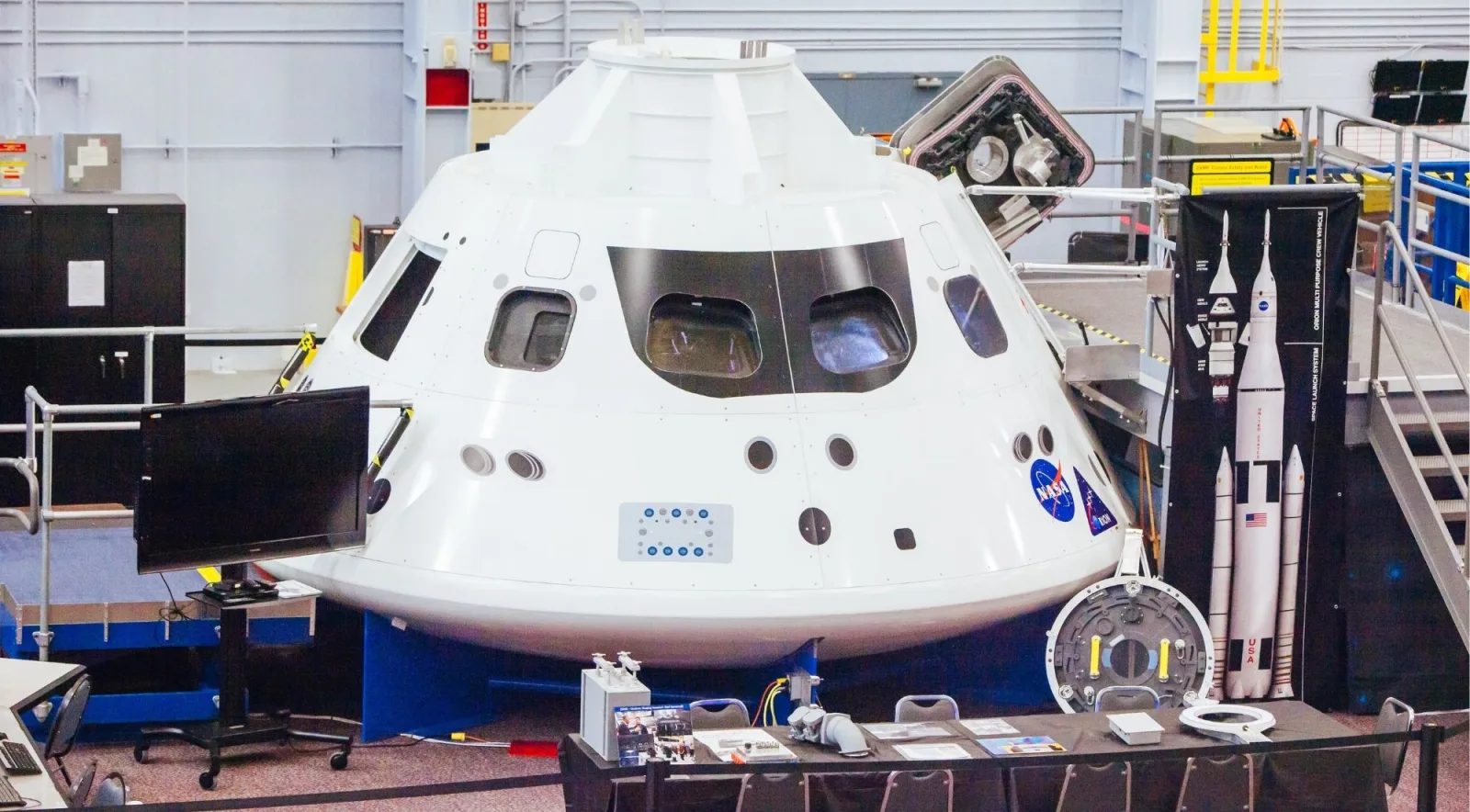
- An Orion capsule display you can photograph from inside — a representative capsule, not a flown vehicle
- A walk-through timeline comparing Artemis with Apollo
- A touch station showing the layers of a next-generation moonwalking suit — see our spacesuit guide for the full story on those
- A comparison of Artemis landing regions with the Apollo landing sites, which does more than anything else in the room to explain why the south pole is a different proposition
- Design activities — build a lunar habitat, create a mission patch
- An illuminated Moon
The flown Orion capsule is not here. The Artemis I crew module returned to Kennedy Space Center in December 2022 for de-servicing and heat shield analysis, and NASA is loaning it to the Smithsonian in Washington. The Artemis II capsule, Integrity, went back to Kennedy in April 2026 for post-flight analysis.
Houston has the manikin who flew. Not the ship.
Other Experiences Worth Pairing With Your Visit
The Artemis gallery costs nothing extra, so the practical questions are how you reach Space Center Houston and what else goes into the day. A round-trip shuttle from downtown Houston (from $80, 4.8★ · 330+ reviews) bundles admission with transport; a NASA-expert-guided visit (from $110, 4.7★ · 60+ reviews) walks the indoor galleries with you and handles tram strategy. The room that runs Artemis flights today isn’t open to the public, but its Apollo-era predecessor is: the Historic Mission Control tram bundle (from $120, 4.7★ · 170+ reviews) reserves those tickets in the same booking. Combo tickets pair NASA with the Houston tunnel system (from $125, 4.7★ · 70+ reviews), and the Houston CityPASS (from $82, 4.6★ · 260+ reviews) folds the Space Center in with the Houston Zoo and the Museum District. Kemah Boardwalk is ten minutes down NASA Parkway; Galveston is under an hour south.
Moon 2 Mars Festival
An annual four-day spring break festival — 11–14 March in 2026, its fifth year.
Daytime programming is included with general admission: STEM activations, robot driving, rocket building, tram tours and over 400 space-flown artifacts. Evening concerts are ticketed separately; 2026 headliners were The Wallflowers and 311, with past years featuring Third Eye Blind and The All-American Rejects.
If you’re planning a March visit, check the dates — it’s one of the busiest and best-programmed weeks of the year.
Where Artemis Stands Now
Artemis I (2022) — Flown, Uncrewed
Launched 16 November 2022, splashed down 11 December 2022. Around 25 days, roughly 1.3 million miles, orbiting beyond the Moon and re-entering at about 24,500 mph — Mach 32.
Successful. But post-flight inspection found something.
The Heat Shield Problem
Orion’s Avcoat heat shield had lost more char than expected — pieces had broken away during re-entry.
The investigation, completed in 2024 with an independent review board, traced it to the skip re-entry profile: gases generated inside the ablative material couldn’t vent as designed, pressure built up, and the char layer cracked and shed. NASA reproduced the effect in arc-jet testing.
The decision NASA made was contentious. The Artemis II heat shield was already built and bonded, so rather than replace it, NASA changed the re-entry trajectory to keep thermal loads within limits. Former astronaut and heat shield specialist Charles Camarda publicly criticised flying crew on that configuration.
After Artemis II flew, NASA reported char loss was significantly reduced and consistent with ground testing. The call held up — but it was a real argument at the time, and it’s part of the story.
Artemis II (2026) — Flown, Crewed
Launched 1 April 2026. Splashed down in the Pacific off San Diego on 10 April.
Crew: Reid Wiseman (commander), Victor Glover (pilot), Christina Koch and Jeremy Hansen of the Canadian Space Agency (mission specialists). Their capsule was named Integrity.
The first crewed flight to the vicinity of the Moon since 1972, and the first crewed flight of SLS and Orion.
They set a record. On 6 April 2026 the crew reached 252,756 miles from Earth — beating Apollo 13’s 1970 record of 248,655 miles by 4,101 miles. Total distance flown: 695,081 miles.
Hansen marked the moment by saying the crew flew in honour of the extraordinary feats of their predecessors, and chose to challenge this generation and the next to make sure the record was not long-lived.
Artemis III (2027) — Redefined
This is the change most coverage hasn’t caught up with.
On 27 February 2026, Administrator Jared Isaacman announced at Kennedy that Artemis III is no longer the lunar landing.
It is now a crewed demonstration in Earth orbit, targeted for 2027, in which an Orion crew will rendezvous and dock with one or both commercial Human Landing System vehicles — SpaceX’s Starship HLS and Blue Origin’s Blue Moon — to prove integrated operations before anyone attempts a landing.
The Apollo parallel is deliberate. Apollo 8 flew around the Moon. Apollo 9 tested the lunar module in Earth orbit. Then Apollo 11 landed. Artemis II was the flyby; Artemis III is the Apollo 9 equivalent; Artemis IV lands.
The crew was announced at Johnson Space Center on 9 June 2026:
| Role | Astronaut |
|---|---|
| Commander | Randy Bresnik |
| Pilot | Luca Parmitano (ESA) |
| Mission specialist | Frank Rubio |
| Mission specialist | Andre Douglas |
| Backup | Bob Hines |
Parmitano is the first ESA astronaut assigned to an Artemis mission — and, as it happens, the astronaut who nearly drowned in his own helmet during a 2013 spacewalk.
Artemis IV (2028) — the Landing
The first crewed lunar landing since Apollo 17 is now Artemis IV, targeted for 2028, at the lunar south pole. NASA is pursuing the possibility of two landings that year, with Artemis V following.
Isaacman has framed the goal as raising SLS cadence to roughly one launch every ten months and flying Artemis III, IV and V before the end of the current presidential term.
What Else Changed in 2026
Two cancellations reshaped the programme.
Gateway Is Cancelled
On 24 March 2026, NASA announced it was suspending the Lunar Gateway “in its current form” — effectively ending a decade of development on the planned lunar-orbit station — and redirecting toward a roughly $20 billion surface base under the name Project Ignition.
The HALO module had already been built in Italy and delivered to Northrop Grumman in Arizona in 2025. NASA has implied some Gateway hardware may be repurposed for surface use.
International partners — ESA, JAXA and the Canadian Space Agency, who had invested in HALO, ESPRIT, I-HAB and Canadarm3 — were left reassessing their contributions.
(Note for visitors: an earlier HALO prototype was donated to Space Center Houston and is displayed inside the visitor complex. It’s now a museum piece for a programme that won’t happen in that form.)
The SLS Upgrade Is Cancelled
NASA cancelled the Exploration Upper Stage and the Block 1B and Block 2 SLS upgrades in February 2026, issuing a stop-work order to Boeing in March.
The reason was cost. EUS development had grown toward $2.8 billion and Block 1B toward $5.7 billion, with years of delay. NASA will keep flying the standardised Block 1 configuration and pursue a commercial upper stage instead.
The Orion Spacecraft
What It Is
Orion is NASA’s crewed deep-space vehicle — the part that carries people and brings them home.
| Orion | Apollo Command Module | |
|---|---|---|
| Crew | 4 | 3 |
| Diameter | 16.5 ft | 12.8 ft |
| Independent duration | Up to 21 days | About a week |
| Docked duration | Up to 6 months | — |
| Reusable | Designed to be | No |
On Artemis I it flew farther from Earth than any human-rated spacecraft ever had — about 268,500 miles.
The European Service Module
The part of Orion that provides propulsion, power, air, water and thermal control is not American. It’s built by Airbus in Bremen, Germany, contributed by ESA and derived from Europe’s Automated Transfer Vehicle.
Four solar array wings span about 19 metres deployed, generating around 11 kilowatts.
This is new territory: the first time NASA has depended on a non-US partner for a mission-critical element of an American human spaceflight vehicle. No European service module, no Artemis.
The Launch Abort System
A 44-foot tower on top of the crew module with three solid motors. If something goes wrong on the pad or during ascent, it fires within milliseconds and pulls the capsule clear.
It’s a “puller” design with the motors above the capsule, the highest-thrust escape system ever tested, and the first puller system able to reorient itself after separation. Validated by Pad Abort-1 in 2010 and Ascent Abort-2 in 2019.
Where It’s Built
The crew module is built by Lockheed Martin, with pressure vessels welded at NASA’s Michoud Assembly Facility in New Orleans — the same plant that built Saturn V first stages — and final assembly at Kennedy.
Five have been built and three have flown: the 2014 test capsule, Artemis I, and Artemis II’s Integrity. The Artemis III and IV vehicles are in production, with the Artemis III heat shield installed in July 2026.
The Space Launch System
Against Saturn V
The comparison people want, done fairly:
| Saturn V | SLS Block 1 | |
|---|---|---|
| Height | 363 ft | 322 ft |
| Liftoff thrust | 7.6 million lb | 8.8 million lb |
| Payload to low orbit | ~118 tonnes | ~95 tonnes |
SLS is more powerful and shorter, and lifts less. More thrust doesn’t mean more payload — engine efficiency, staging and structural mass all matter. NASA’s own framing is that Block 1 produces about 15% more thrust than Saturn V.
It’s still the most powerful rocket NASA has flown.
The Cost Problem
NASA’s Office of Inspector General projected the production and operations cost of a single SLS and Orion at around $4.1 billion per launch for Artemis I through IV. The then-Inspector General told a House subcommittee the price was “unsustainable.”
The same office reported that NASA’s overall Artemis investment from 2012 through 2025 was projected to reach $93 billion, with SLS accounting for $23.8 billion through 2022.
The other criticism is cadence. More than three years passed between Artemis I and Artemis II. Isaacman has tied that gap directly to reliability problems and made increasing launch rate a stated priority.
Why Houston
The Artemis exhibit here isn’t borrowed content. The programme is run next door.
Johnson Space Center manages the Orion programme — programme management and the crew module, service module and abort system offices are all based at JSC.
Mission Control runs Artemis flights from just after launch through splashdown, from the modernised White Flight Control Room in the same Building 30 complex that houses the restored Apollo room. A new Orion Mission Evaluation Room is staffed jointly by NASA, Lockheed, ESA and Airbus engineers.
The Artemis II crew trained here — in the full-scale Orion mockup in Building 9, in the Neutral Buoyancy Laboratory for recovery procedures, and in T-38 jets from nearby Ellington Field.
The Artemis III crew was announced at JSC on 9 June 2026.
More on the relationship between the museum and the working NASA campus: Johnson Space Center vs Space Center Houston.
How to Think About It
The simple version, for anyone standing in the gallery:
Artemis is a step-by-step test campaign, the same way Mercury led to Gemini led to Apollo.
- Artemis I (2022) — test the rocket and capsule with nobody aboard ✅
- Artemis II (2026) — put a crew around the Moon and bring them back ✅
- Artemis III (2027) — test docking with the landers, in Earth orbit
- Artemis IV (2028) — land
And the caveat. Those dates are targets. NASA’s own Inspector General and the GAO have repeatedly flagged the landers as the biggest risk: SpaceX still needs to demonstrate orbital propellant transfer and an uncrewed landing, and Blue Origin had roughly half its 2024 design review action items still open as of August 2025.
The sequence is now clearer and more Apollo-like than it has been in years. The dates have slipped before and could slip again.
Two ways Artemis differs from Apollo:
- The landers are commercially owned. NASA is buying a service, not building the vehicle. That’s a structural change, not a detail
- The goal is to stay. Apollo was flags and footprints over hours. Artemis targets the south pole, longer surface stays, and eventually a base
Whether that’s achievable on the current budget and schedule is exactly what the arguments are about.
Plan your visit. The Artemis exhibit is included with admission alongside the other indoor galleries — see tickets and pricing, and hours and planning for opening times and parking.
Frequently Asked Questions
What is the Artemis exhibit at Space Center Houston?
A permanent gallery, included with general admission, that opened in June 2022. Its centrepiece is Commander Moonikin Campos — the actual manikin that flew in Orion’s commander’s seat on Artemis I in 2022. It also includes an Orion capsule display, a spacesuit touch station, an Apollo-versus-Artemis timeline and design activities. Allow 30 to 45 minutes.
Who is Moonikin Campos?
Campos is the sensor-equipped manikin that occupied the commander’s seat aboard Orion during Artemis I, recording the radiation, acceleration and vibration a human crew would have experienced. He’s named after Arturo Campos, the electrical power subsystem manager for the Apollo 13 lunar module, whose work helped bring that crew home. The name was chosen by a public vote in which more than 300,000 people took part.
Has Artemis II flown?
Yes. Artemis II launched on 1 April 2026 and splashed down on 10 April, carrying Reid Wiseman, Victor Glover, Christina Koch and Jeremy Hansen around the Moon and back — the first crewed flight to lunar distance since 1972. The crew set a human distance record of 252,756 miles from Earth, beating Apollo 13’s 1970 mark by over 4,000 miles.
When will NASA land on the Moon again?
The first crewed landing is now targeted for 2028 on Artemis IV, at the lunar south pole. This changed in February 2026, when NASA redefined Artemis III as a crewed Earth-orbit docking test with the commercial landers, targeted for 2027. Independent oversight has flagged the landers as the main schedule risk, so 2028 should be read as a target rather than a certainty.
Is Artemis III still the Moon landing?
No. As of February 2026, Artemis III is a crewed demonstration mission in Earth orbit in which the crew will rendezvous and dock with one or both commercial Human Landing System vehicles. It’s deliberately analogous to Apollo 9, which tested the lunar module in Earth orbit before Apollo 11 landed. The first landing is now Artemis IV.
What happened to the Lunar Gateway?
NASA announced on 24 March 2026 that it was suspending Gateway in its current form, effectively cancelling the planned lunar-orbit station, and redirecting resources toward a lunar surface base. The HALO module had already been built and delivered. International partners who had invested in Gateway components were left reassessing their contributions.
How does SLS compare to the Saturn V?
SLS Block 1 is shorter — 322 feet against Saturn V’s 363 — but produces about 15% more thrust at liftoff, roughly 8.8 million pounds against 7.6 million. However, Saturn V could lift more to low Earth orbit, around 118 tonnes against SLS Block 1’s 95. SLS is the most powerful rocket NASA has flown, but not the most capable lifter ever built.
Can you see the Orion capsule that flew?
Not in Houston. The Artemis I crew module went back to Kennedy Space Center for analysis and is being loaned to the Smithsonian in Washington. The Artemis II capsule, Integrity, returned to Kennedy in April 2026. The Orion capsule in the Houston exhibit is a representative display, though the flown Moonikin Campos manikin is genuine.
See NASA's Home of Human Spaceflight
Join the visitors who rate Space Center Houston a highlight of their trip — the Saturn V rocket, Historic Mission Control, the world's largest public moon-rock collection, and Independence Plaza. Reserve timed admission with free cancellation.
Check Availability & Book