Real Moon Rocks at Space Center Houston (and Where to Touch One)
Yes, you can touch a real Apollo 17 moon rock in Starship Gallery — included with admission. Which sample it is, and the vault at NASA where the rest are kept.
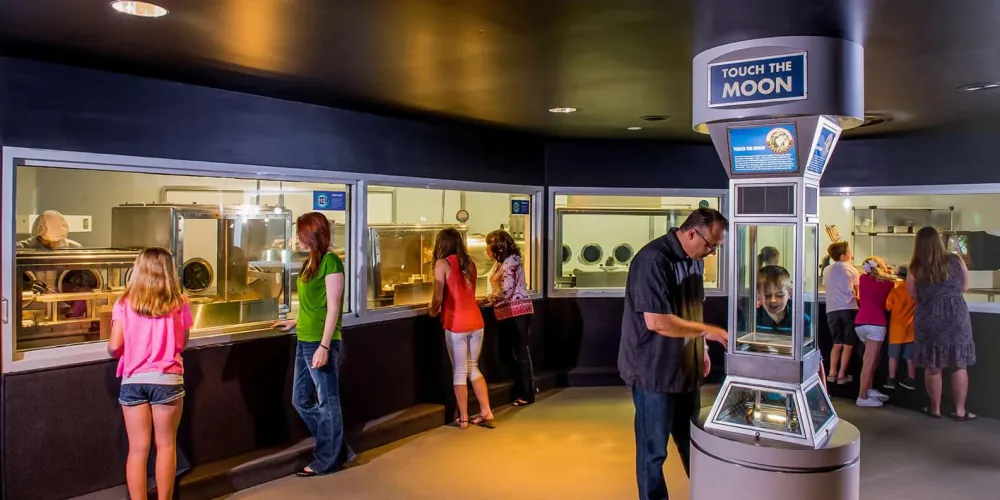
Yes — you can touch a real piece of the Moon here. It’s in the Lunar Samples Vault inside Starship Gallery, it’s included with general admission, and you touch it with a fingertip through an opening in the case rather than looking at it through glass.
It’s small. It’s worn smooth. And it came off the lunar surface in December 1972.
Here’s exactly what it is, and why the collection it belongs to is the most scientifically valuable set of rocks on Earth.
Included with general admission — no upcharge, no separate booking. The Lunar Samples Vault sits inside Starship Gallery, so the Space Center Houston Admission Ticket (from $29, 4.5★ · 3,846 reviews) is all you need; it’s the official timed-entry ticket with free cancellation. Our tickets guide breaks down every tier and price.
The Touchable Rock
What it actually is
The lunar touchstone is a polished slice of Apollo 17 basalt sample 70215 — specifically daughter sample 70215,238.
Sample 70215 was the largest single rock Apollo 17 brought home, weighing around 8 kilograms. It was collected by Gene Cernan and geologist-astronaut Harrison “Jack” Schmitt in the Taurus-Littrow Valley in December 1972 — the last Apollo landing, and Schmitt remains the only professional geologist to have worked on the Moon.
Space Center Houston dates it at 3.8 billion years old.
How you touch it
Not through glass. The rock sits in a case with a hand opening, and visitors reach in and touch it with one finger.
The result of decades of that is a detail worth knowing before you go: the rock has been polished glassy by the oil from millions of fingertips. A Space Center spokesperson once described how the combination of skin oil and Houston humidity had turned its surface soft and silky.
You’re not touching a rough rock. You’re touching something that generations of visitors have worn smooth.
How many exist
Fewer than you’d think — and the count is genuinely disputed.
Space Center Houston and NASA both say eight lunar rocks are available for the public to touch worldwide.
The Smithsonian’s more recent framing points to five permanent museum displays:
| Museum | Sample |
|---|---|
| Smithsonian National Air and Space Museum, Washington DC | 70215,84 |
| Space Center Houston | 70215,238 |
| Kennedy Space Center Visitor Complex, Florida | 70215,287 |
| Museum of Science, UNAM, Mexico City | 70215,286 |
| H.R. MacMillan Space Centre, Vancouver | 70215,263 |
The “eight” figure appears to include additional daughter samples used in NASA’s travelling exhibits.
Notice the sample numbers. Every touchable Apollo rock on the planet is a slice of the same rock — 70215. They’re siblings.
The Smithsonian’s was the first, going on display in 1976, credited to Farouk El-Baz.
The Lunar Samples Vault
The vault itself is a certified clean-room replica, built with the same style of equipment NASA uses in its actual curation lab. The samples inside are genuine, kept in a pure nitrogen environment exactly as they are at NASA — because Earth’s oxygen and water would rust and chemically alter material that has never encountered either.
There’s also a cross-section of a lunar sample under a microscope, which is where the geology becomes visible.
Space Center Houston describes it as “the largest display of Moon rocks on public display in the world.”
Worth being straight about this. That’s Space Center Houston’s own claim, and it’s plausible — but no neutral authority has verified it. The world’s real Apollo collection isn’t on display anywhere. It’s in storage a few miles away.
What you’re looking at
The Apollo samples fall into four broad types, which are easier to appreciate once you know what separates them:
Basalt — dark volcanic rock from the lunar “seas,” the maria. Solidified lava. Lunar basalts are often unusually rich in titanium. This is what the touchable rock is.
Breccia — a rock made of other rocks. Fragments, minerals and glass welded together by the heat and pressure of meteorite impacts.
Anorthosite — pale rock made largely of plagioclase feldspar. It forms the Moon’s bright ancient highlands, and it floated to the surface of the early molten Moon.
Regolith — the fine grey dust and fragments blanketing everything. Unlike Earth soil it contains no organic material whatsoever. Core samples are tubes of it, preserving the layers.
Other Experiences Worth Pairing With Your Visit
The touchstone costs nothing extra, so the real questions are how you get out to Space Center Houston and what else you build the day around. A round-trip shuttle from downtown Houston (from $67, 4.8★ · 301 reviews) bundles admission with transport and removes the parking question; a NASA-expert-guided visit (from $96, 4.7★ · 62 reviews) walks you through Starship Gallery and handles tram strategy. If the restored Historic Mission Control matters to you, the Mission Control tram bundle (from $100, 4.7★ · 169 reviews) reserves those tickets in the same booking. Combo tickets pair NASA with a downtown Houston city tour (from $98, 4.3★ · 522 reviews) or the Houston tunnel system (from $118, 4.9★ · 69 reviews), and the Houston CityPASS (from $72, 4.6★ · 265 reviews) folds the Space Center in with the Museum District and the Houston Zoo. Nearby, Kemah Boardwalk is ten minutes down NASA Parkway and Galveston is under an hour south.
Where the Rest of Them Are
A few miles from the exhibit, on the Johnson Space Center campus, sits Building 31N — the Lunar Sample Laboratory Facility. It holds the most valuable rock collection in existence.
You cannot visit it. NASA’s own curation materials describe it as a working laboratory, not a museum. Access is essentially limited to approved researchers, educators and the occasional VIP. Around a hundred people a year get in.
The replica vault at Space Center Houston exists precisely because the real one is off-limits.
The numbers
Six Apollo landings — 11, 12, 14, 15, 16 and 17 — returned:
- 382 kilograms (842 pounds) of lunar material
- Around 2,200 individual specimens, since subdivided into more than 110,000 catalogued samples
- 16.5 metres of core tubes
For scale: the Soviet Luna robotic missions returned about 300 grams in total. Apollo brought back more than a thousand times that.
How they’re kept
Pristine samples are handled inside stainless steel glove boxes purged with flowing high-purity nitrogen. Only aluminium, stainless steel and Teflon are permitted to touch lunar material — nothing else is chemically inert enough.
Cabinets are mission-specific, so samples from different landing sites can never cross-contaminate.
Roughly 70–75% of the collection by mass sits in the Pristine Sample Vault. A separate Return Sample Vault holds material that researchers have borrowed and sent back — around 48,000 samples that can no longer be considered pristine.
The vaults are elevated within the building, specifically to survive hurricane storm surge.
The secret convoy
In 1976, NASA decided that keeping an irreplaceable collection in one hurricane-exposed building was reckless.
So one night, under police escort and without public announcement, about 14% of the collection was moved to a bunker at Brooks Air Force Base in San Antonio. When Brooks began transitioning out of military control in the early 2000s, that portion moved again — to the White Sands Test Facility in New Mexico, where roughly 52 kilograms remain today.
Rocks saved for a future that hadn’t happened yet
The most far-sighted decision NASA made about the Apollo samples was not to study them.
A substantial fraction of the collection was deliberately sealed and left untouched, on the reasoning that future instruments would extract more from the material than 1970s laboratories ever could.
That judgement paid off in the Apollo Next-Generation Sample Analysis programme.
Its centrepiece was an Apollo 17 double drive tube — samples 73001 and 73002 — collected from a landslide deposit near Lara Crater. The upper segment was opened in November 2019. The lower segment, 73001, had been vacuum-sealed on the lunar surface and never opened. It was one of only two such samples in existence.
In March 2022, fifty years after it was collected, NASA extracted the gas trapped inside and opened it. Preliminary examination concluded in 2023.
ANGSA was explicitly designed as a bridge to Artemis — a chance for curators to rehearse modern handling techniques on genuine lunar material before new samples arrive.
The Famous Rocks (and Where They Aren’t)
Two Apollo samples are famous enough to have names. Neither is on display.
The Genesis Rock
Apollo 15, sample 15415. Collected by David Scott and James Irwin at Spur Crater in 1971 — an anorthosite weighing about 269 grams.
Scott’s radio call on finding it has become one of the quotable moments of the programme: “Guess what we just found! I think we found what we came for.”
They believed they’d found a piece of the Moon’s original crust. Later dating put it at roughly 4.0–4.1 billion years — not quite primordial, but close enough to be extraordinary.
It’s in Houston, in Building 31N. Not on display.
Big Muley
Apollo 16, sample 61016. At 11.7 kilograms, the largest single rock returned by any Apollo mission, collected from the lunar highlands and named after field geologist Bill Muehlberger.
Some of its components may be around 4.5 billion years old.
A distinction worth getting right: Apollo 17’s sample 70215, at around 8 kg, was the largest rock of that mission and the source of every touchable moon rock in the world. Big Muley, at 11.7 kg, is the largest of the entire programme. The two get conflated constantly.
What the Samples Actually Taught Us
This is why the collection matters more than its size suggests.
The age of the Moon. The samples fixed it at roughly 4.5 billion years — essentially the same age as Earth.
The magma ocean. The Moon was once molten to great depth. Light anorthosite crystallised and floated to the top, forming the bright highlands you can see from your garden. The dark maria are later lava flows filling impact basins.
The giant impact hypothesis. The samples came back bone-dry, depleted in volatile elements, and with oxygen isotope ratios almost identical to Earth’s. That combination pointed strongly toward the Moon forming from debris after a Mars-sized body struck the early Earth.
The bombardment record. The lunar surface preserves a history of early Solar System impacts that Earth’s geology has long since erased.
Why they still matter
Because the instruments keep improving. As one lunar scientist has put it, analytical technology is constantly evolving — which is why lunar samples are often called the gift that keeps on giving.
Work published in recent years, dating zircon crystals from Apollo material, has continued to refine our understanding of the Moon’s age using rocks collected more than fifty years ago.
The Moon Rocks That Went Missing
After Apollo 11 and Apollo 17, President Nixon gave small lunar fragments mounted on commemorative plaques to 135 countries, all 50 US states, and US territories.
Many of them are gone.
By the accounting of retired NASA investigator Joseph Gutheinz — known as the Moon Rock Hunter — of roughly 370 fragments distributed, around 184 are lost, stolen or unaccounted for.
The individual stories are remarkable:
- Ireland’s Apollo 11 rock was lost in a 1977 observatory fire and ended up in a landfill
- Honduras’s Apollo 17 rock was recovered in a 1998 undercover sting operation
- Colorado’s turned up hanging on a former governor’s wall
- Minnesota’s Apollo 11 fragments resurfaced in 2012
Can you own a moon rock?
Apollo samples: no. They are United States government property, have never been sold, and trafficking in them is a federal crime.
Lunar meteorites: yes. Rocks blasted off the Moon by impacts that later fell to Earth are legal to own and trade. Reputable dealers sell small specimens for a few hundred dollars.
One legal exception exists among mission-returned material. The Soviet Union gifted three tiny Luna 16 grains — about 0.2 grams — to Nina Koroleva, widow of chief designer Sergei Korolev. They sold at Sotheby’s in 2018 for $855,000.
The 2002 theft
In 2002, a NASA co-op intern named Thad Roberts, working with two accomplices, stole a roughly 600-pound safe from Building 31 containing lunar, meteorite and Martian samples representing every Apollo landing.
They used genuine NASA badges to get in, then tried to sell the material online. An FBI sting in Orlando ended it, with arrests on 20 July 2002 — the 33rd anniversary of the Apollo 11 landing.
The real damage wasn’t the theft. The samples were contaminated and rendered scientifically useless, and decades of Dr. Everett Gibson’s research notes were destroyed in the process.
Roberts was sentenced to over eight years and served roughly six.
What Comes Next: Artemis
Johnson Space Center’s Astromaterials Research and Exploration Science division will curate the samples Artemis brings back. Dr. Juliane Gross serves as Artemis Campaign Sample Curation Lead — a role she has described as representing the voice of the Moon rocks.
The facility is being prepared for material from the lunar south pole, which presents genuinely new problems. Samples from permanently shadowed regions may need to be kept cold from collection through to analysis, something Apollo never had to solve.
Meanwhile, in a move designed largely to establish legal precedent for buying space resources, NASA in 2020 contracted four companies to collect small samples of lunar regolith in place — for a combined total of $25,001. One firm bid $1.
Visiting the Vault
Where it is: inside Starship Gallery, which also holds the Apollo 17 Command Module, Mercury and Gemini capsules, a Skylab trainer and a lunar module replica.
How long: allow 30–45 minutes for Starship Gallery overall. The vault itself is a stop of a few minutes.
Best time: weekday mornings during term time. Arriving at opening also secures your tram tour boarding pass — the same tram that runs out to Rocket Park and the Saturn V, and, on the paid add-on, to Historic Mission Control.
Photography: permitted. No tripods, monopods, selfie sticks, drones or long lenses.
Accessibility: fully wheelchair accessible, with rentals available.
Manage your expectations
The most common disappointment is scale. Visitors arrive picturing a boulder and find a small, smooth, unremarkable-looking slice of dark rock.
It helps to reframe what you’re touching. This is material from a place twelve human beings have ever stood. It formed 3.8 billion years ago, sat undisturbed until two men picked it up in December 1972, and it is one of only a handful of pieces of another world that any member of the public is permitted to touch anywhere on Earth.
It doesn’t look like much. That’s not the point.
Plan your visit. Starship Gallery and the Lunar Samples Vault are included with admission — see tickets and pricing for every tier.
Frequently Asked Questions
Can you touch a real moon rock at Space Center Houston?
Yes. The lunar touchstone in the Lunar Samples Vault inside Starship Gallery is a genuine slice of Apollo 17 basalt, collected in the Taurus-Littrow Valley in December 1972 and around 3.8 billion years old. You touch it with one finger through an opening in the display case, and it’s included with general admission at no extra cost.
Where can you touch a moon rock in the world?
There are five permanent museum displays where the public can touch genuine Apollo material: the Smithsonian National Air and Space Museum in Washington DC, Space Center Houston, the Kennedy Space Center Visitor Complex, the Museum of Science at UNAM in Mexico City, and the H.R. MacMillan Space Centre in Vancouver. NASA and Space Center Houston sometimes cite eight, which appears to include samples used in travelling exhibits. All are slices of the same Apollo 17 rock, sample 70215.
How many moon rocks did Apollo bring back?
The six Apollo landings returned 382 kilograms — 842 pounds — of lunar material, comprising around 2,200 individual specimens that have since been subdivided into more than 110,000 catalogued samples, plus 16.5 metres of core tubes. By comparison, the Soviet Luna robotic missions returned about 300 grams in total.
Can you visit NASA’s Lunar Sample Laboratory?
No. Building 31N at Johnson Space Center, where the Apollo collection is curated, is a working laboratory rather than a museum. Access is limited to approved researchers, educators and occasional official visitors — around a hundred people a year. The Lunar Samples Vault at Space Center Houston is a certified clean-room replica built so the public can see genuine samples stored the same way.
Is it legal to own a moon rock?
Apollo samples are United States government property and cannot legally be owned or sold by private individuals — trafficking in them is a federal crime. Lunar meteorites, which reached Earth naturally after impacts blasted them off the Moon, are entirely legal to own and are sold by reputable dealers. The only mission-returned material ever legally sold is a set of three tiny Luna 16 grains, which fetched $855,000 at auction in 2018.
Why are moon rocks kept in nitrogen?
Because Earth’s atmosphere would alter them. Oxygen and water vapour cause lunar material to rust and form clay minerals it never encountered on the Moon. NASA stores pristine samples in stainless steel cabinets purged with flowing high-purity nitrogen, and only aluminium, stainless steel and Teflon are permitted to touch them.
What is the Genesis Rock?
Sample 15415, an anorthosite weighing about 269 grams, collected by David Scott and James Irwin at Spur Crater during Apollo 15 in 1971. It was believed to be a fragment of the Moon’s original crust; later dating put it at around 4.0–4.1 billion years old. It’s held at Johnson Space Center’s curation facility and is not on public display.
What did moon rocks teach us?
They established the Moon’s age at roughly 4.5 billion years, showed that it was once molten to great depth with light crustal rock floating to the surface, and provided the compositional evidence — bone-dry, volatile-depleted, with Earth-like oxygen isotopes — that underpins the giant impact hypothesis of the Moon’s formation. They also preserve a record of early Solar System bombardment that Earth’s geology has erased.
See NASA's Home of Human Spaceflight
Join the visitors who rate Space Center Houston a highlight of their trip — the Saturn V rocket, Historic Mission Control, the world's largest public moon-rock collection, and Independence Plaza. Reserve timed admission with free cancellation.
Check Availability & Book