Independence Plaza: Walking Through a Shuttle Mounted on a 747
The only place on earth you can walk inside both a space shuttle and the 747 that carried it. What's real, what's replica, and what you actually see inside.
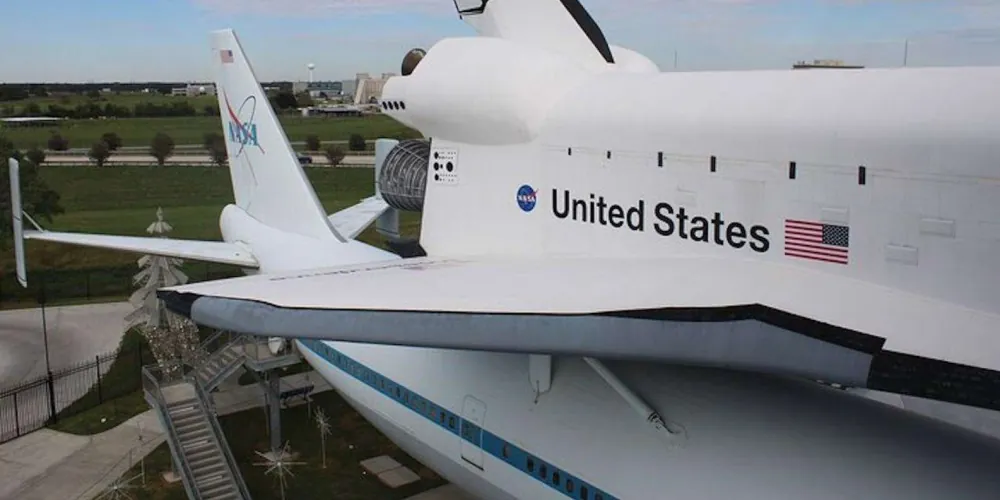
There’s an inversion at the heart of this exhibit that most visitors never learn, and it’s the best thing about it.
The space shuttle everyone photographs — the one perched eight stories up, the one in every Houston tourism advert — is a replica. It never flew.
The Boeing 747 underneath it is entirely real. NASA 905 carried actual orbiters across the country 223 times over 42 years, and it’s the largest intact artifact remaining from the entire Space Shuttle Program.
So the famous part is a copy, and the part people walk past is the genuine article. Once you know that, the whole exhibit reads differently.
Independence Plaza is included with general admission. No separate ticket, no upcharge — you just need to be inside the building, and you should allow around 45 minutes here. The Space Center Houston Admission Ticket (from $29, 4.5★ · 3,846 reviews) is the official timed-entry ticket with free cancellation; see our tickets guide for every tier and price.
What It Is
Independence Plaza opened on 23 January 2016 after roughly four years of work and a $12 million build, sponsored by Boeing — which also supplied the engineers who took the 747 apart and put it back together.
It is the only display of its kind anywhere in the world. Not just the only shuttle mounted on a carrier aircraft on public display — the only place where the public can go inside both vehicles. Every other retired orbiter, and the second carrier aircraft, can only be viewed from the outside.
The structure
- 240 tons total, sitting on a 15-inch concrete foundation over 20 inches of compacted sand
- Nearly 80 feet tall to the tip of the shuttle’s tail — eight stories
- About 232 feet long
- A six-story access tower with two elevators and a stairway, plus open-air vestibules where you board each aircraft
You enter from the top. The route takes you into the shuttle first — flight deck, then mid-deck, then out into the payload bay — before descending into the 747 below. It mirrors the real relationship between the two craft.
One engineering detail worth appreciating: because this aircraft is now effectively a building, afternoon sun heating one side causes the front landing gear to shift. The centre also had to work out how to air-condition a historic airframe without altering it.
The Shuttle: Independence
It used to be called something else
The replica was built by Guard-Lee Inc. in Apopka, Florida, from NASA and contractor blueprints — reportedly the highest-fidelity shuttle model ever made. It stood at the Kennedy Space Center Visitor Complex from 1993 under the name Explorer, for about eighteen years.
Then Kennedy was awarded the real orbiter Atlantis, and Explorer had to go.
How it got to Texas
The journey is a genuinely good story.
It was removed from Kennedy on 11 December 2011 on a 144-wheel trailer — light poles and signage came down, and the model was jacked up over a guardhouse on hydraulic lifts. Its “Explorer” name was stripped off before departure.
On 24 May 2012 it set sail on an open-air barge, towed by two ocean-going tugs around the Florida peninsula and across the Gulf of Mexico — roughly 800 miles. It entered Galveston Bay on 31 May and reached Clear Lake on 1 June 2012, an eight-day voyage greeted by a flotilla and a public celebration.
The last mile was the hard part. On 3 June it was trucked to Space Center Houston on a 144-wheel transporter. The trip was scheduled for three hours and took about six — a traffic light had to be hoisted out of the way at the very first turn.
The naming contest
Space Center Houston ran a statewide contest from 4 July to 2 September 2013 — Independence Day to Labor Day — looking for a name that captured Texan independence and optimism.
It drew 10,263 entries. The winning name was announced on 5 October 2013, first submitted by Tim Judd, then 29, of Kingwood, Texas. His name and hometown are worked into the finished exhibit.
Specifications
- Length: 122 feet
- Wingspan: 78 feet
- Height: 57 feet
- Weight: around 171,000 pounds
It was extensively renovated in 2013–14: re-skinned, with replica tiles updated to match the later orbiter fleet, and the interior opened out and enlarged for visitors.
What’s real inside it
Most of the shuttle is representative — the airframe, the thermal tiles, the reinforced carbon-carbon wing panels and the robotic arm are all simulated.
But two things aren’t.
The Michelin landing gear tires are authentic Space Shuttle Program hardware.
The Intelsat satellite cradle in the payload bay actually flew. It went up on Endeavour’s maiden flight, STS-49, in 1992 — the satellite rescue mission that produced the first and only three-person spacewalk. The kick motor and satellite displayed beside it are mockups; the cradle is the real thing.
What you see
The two-level crew cabin is the heart of it. You come into the flight deck, where you can sit in the commander and pilot seats. Then the mid-deck — the living and working space, which does an effective job of conveying how genuinely cramped life was for crews spending up to two weeks in there. Then you walk out into the payload bay.
Fair warning: it’s tighter than most people expect, and quicker to tour than the exterior suggests.
Other Experiences Worth Pairing With Your Visit
Independence Plaza costs nothing extra, so the real question is how you get to Space Center Houston and how much of the day you hand to someone else. A round-trip shuttle from downtown Houston (from $67, 4.8★ · 301 reviews) bundles admission with transport and removes the parking question; a NASA-expert-guided visit (from $96, 4.7★ · 62 reviews) walks you through the plaza and handles tram strategy; and if the restored Historic Mission Control matters to you, the Mission Control tram bundle (from $100, 4.7★ · 169 reviews) reserves those tickets in the same booking. Combo tickets also pair NASA with a downtown Houston city tour (from $98, 4.3★ · 522 reviews) or the Houston tunnel system (from $118, 4.9★ · 69 reviews). Out in Clear Lake, Kemah Boardwalk is ten minutes down NASA Parkway and Galveston is under an hour south.
The 747: NASA 905
This is the part worth slowing down for.
From airliner to spacecraft carrier
NASA 905 is a Boeing 747-123, serial number 20107. It first flew on 15 October 1970 and was delivered to American Airlines on 29 October 1970 as N9668 — an ordinary passenger jet.
NASA bought it on 18 July 1974 for $15,601,192.19, initially for wake-vortex research. Boeing carried out the major conversion work in 1976.
What the conversion involved:
- Structural reinforcement throughout the airframe
- Mounting struts on top of the fuselage to carry an orbiter
- Two large vertical fins added to the ends of the horizontal stabiliser for directional stability — the most visually distinctive change
- The passenger cabin stripped entirely
- A crew escape system for the test programme: an exit tunnel from the flight deck to a bottom hatch with pyrotechnic release, removed afterwards
The American Airlines livery came off, and by 1983 it wore NASA’s white and blue.
Why carrier aircraft existed at all
Orbiters had no air-breathing engines. They couldn’t fly anywhere under their own power.
When weather or mission profile sent a landing to Edwards Air Force Base in California instead of Kennedy — which happened on 54 of the 135 shuttle missions — the orbiter had to get back to Florida somehow. Piggyback on a modified 747 was the only practical answer.
Ferry flights were far more delicate than they look. At ferry speed, raindrops could damage the heat shield tiles. The aircraft carried little spare fuel for weather diversions. So flights hopped between military airbases waiting for clear skies, sometimes descending to 10,000 feet hunting for good conditions.
At each end, huge gantry structures called Mate-Demate Devices hoisted the 100-ton orbiter on and off. The one at Edwards stood around 100 feet tall and could lift more than 220,000 pounds.
The Enterprise tests
NASA 905’s first major job was the Approach and Landing Tests of 1977, carrying the prototype Enterprise at Edwards.
The programme built up carefully: three taxi tests in February 1977, five captive-inert flights, then three captive-active flights with astronauts aboard but still attached. Finally, five free flights between 12 August and 26 October 1977, with Enterprise separating via explosive bolts and gliding down.
The first free flight, on 12 August 1977, was flown by Fred Haise and Gordon Fullerton, released at 8:48am. It drew roughly 65,000 spectators, 900 press and 2,000 guests. Joe Engle and Richard Truly alternated on later flights.
The first three free flights used an aerodynamic tail cone to cut drag. The last two flew with the engine nozzles exposed — as an orbiter would look returning from space.
These tests proved an orbiter could glide home and land safely. Without them, there is no Space Shuttle Program. NASA 905 is the reason they were possible.
The career
Over 42 years, NASA 905:
- Carried orbiters 223 times
- Logged around 11,017 flight hours
- Made about 6,334 takeoffs
- Flew 70 of the 87 operational ferry missions, including 46 of the 54 post-mission returns from California to Florida
Its final act was carrying the fleet to retirement in 2012 — Discovery to the Smithsonian, Enterprise to New York, and Endeavour to Los Angeles.
It flew to Ellington Field in Houston on 24 October 2012, and made a last 90-minute farewell flight over the city on 18 December 2012.
The Big Move
Getting a 747 eight miles by road is not simple.
Boeing’s Aircraft on Ground team began dismantling it in the open at Ellington on 17 February 2014 — the first time Boeing had ever removed a 747’s wings in the field rather than in a hangar. The process took around 38 to 40 days.
The aircraft was split into large sections and moved by a convoy roughly 1,000 feet long, travelling at about 3 miles per hour — walking pace — down Old Galveston Road and NASA Parkway.
It moved only at night, across 28 and 29 April 2014, arriving on the 30th. Around 110 power lines had to be moved out of the way. By comparison, the shuttle replica’s road move had required moving one.
In August 2014 the replica was hoisted onto the aircraft’s back in a public event billed as the Rise of Independence.
A detail that says something about the care taken: although the main landing gear beam was cut for transport, the reassembled aircraft remains flight-certifiable.
What you see inside
The cabin was stripped and rebuilt as a walk-through museum running the length of the aircraft, telling NASA 905’s story from airliner to shuttle carrier to retirement.
Hands-on exhibits include a replica wind tunnel demonstrating how NASA verified that the mated pair could actually fly — the physics of the pairing genuinely was improbable, and the exhibit explains why it worked.
The cockpit retains its original analogue instruments. Some of the original first-class furnishings and carpeting reportedly remain aboard.
The whole installation meets Smithsonian display standards, with temperature and humidity control engineered into the historic airframe.
And the other one
NASA had a second carrier aircraft, NASA 911 — a Boeing 747-100SR built in 1973 for Japan Airlines, acquired by NASA in 1988. It flew far fewer missions, around 66 with a shuttle attached.
It’s now on outdoor static display at the Joe Davies Heritage Airpark in Palmdale, California. Free to visit — but exterior viewing only.
That’s the clearest illustration of what makes Houston’s exhibit unusual.
One More Real Artifact
Don’t walk past the Orbiter Access Arm at the plaza. This is the actual gantry arm from Launch Pad 39B at Kennedy Space Center, removed in 2009 as the pad was cleared.
Its “white room” — the enclosed chamber at the end — held six people and was the last thing astronauts passed through before boarding. It stayed extended until 7 minutes 24 seconds before launch as an emergency escape route, which is why the arrows on it point away from the orbiter.
It served 53 shuttle missions from Pad 39B between 1986 and 2006, including the first launch from that pad — STS-51L, Challenger, on 28 January 1986 — and the STS-26 return to flight in 1988.
Why Houston Has a Replica
This is the uncomfortable part of the story, and it explains the whole exhibit.
On 12 April 2011, NASA Administrator Charles Bolden announced where the four surviving orbiters would go, chosen from 29 competing institutions:
- Discovery → Smithsonian, Virginia
- Atlantis → Kennedy Space Center, Florida
- Endeavour → California Science Center, Los Angeles
- Enterprise → Intrepid Museum, New York
Houston — home of Mission Control, home of the astronaut corps, the city whose name was the first word spoken from the Moon — got nothing.
Texas politicians reacted furiously, and several publicly called the decision political. President Obama denied it. A NASA Inspector General review later found errors in the evaluation process but no proof of political motivation. Bolden said he’d have loved to place an orbiter in Houston, but cited lower attendance and fewer international visitors.
Space Center Houston received the replica and NASA 905 instead.
And there’s an argument that it worked out. The centre’s own exhibits manager has pointed out that the flown orbiters are sealed — their interiors closed to preserve them. The replica could be opened up, enlarged and fitted with exhibits. You can sit in Independence’s pilot seat. You cannot sit in Atlantis’s.
The story isn’t over
In July 2025, legislation was signed allocating $85 million to move a space vehicle — understood to mean Discovery — from the Smithsonian to Space Center Houston.
The Smithsonian has resisted, asserting it legally owns Discovery and warning about damage risk, with cost estimates ranging from $120 million to as much as $400 million depending on who’s counting.
As of now this is unresolved. Treat any claim that Houston is definitely getting Discovery with caution.
Visiting Practically
How long: around 45 minutes.
Order: you enter the shuttle first by design, then descend into the 747. Follow it.
Cost: included with general admission. No upcharge.
Photography: permitted throughout.
For opening hours, the last tram departure and the $10 parking charge, see our hours, parking and address guide.
Is it suitable for you?
| Consideration | Reality |
|---|---|
| Mobility limitations | Currently difficult to impossible — stairs only during the elevator outage. Verify status first |
| Claustrophobia | The crew cabin and connecting passages are genuinely tight |
| Fear of heights | The tower and open-air vestibules go up several stories |
| Young children | Generally enjoyed, and the hands-on exhibits work well — but factor in the climb |
The one mistake to avoid
Don’t leave Independence Plaza until the end of the day. A recurring complaint in reviews is that the plaza can close before the main building does — some visitors report a hard 5pm close — and people miss it entirely after spending the afternoon elsewhere.
Do it early, or immediately after your tram tour out to Rocket Park and the Saturn V.
What reviewers say
The good: the scale is the thing. People describe genuine awe, and note how the enormous 747 somehow looks dwarfed by the shuttle on its back — which drives home exactly how improbable the engineering was.
The less good: the shuttle interior is smaller and faster to walk than expected, and it gets crowded at midday. Some visitors feel the experience is over quickly relative to the build-up.
Plan your visit. Independence Plaza comes free with admission, but the timing matters — go early rather than saving it for last.
Frequently Asked Questions
Is the space shuttle at Space Center Houston real?
The shuttle Independence is a high-fidelity replica — it never flew in space. However, the Boeing 747 it sits on, NASA 905, is entirely genuine: it carried real orbiters 223 times over 42 years and is the largest intact artifact from the Space Shuttle Program. Some authentic flown hardware is inside the replica too, including the Intelsat satellite cradle from the STS-49 mission.
Can you go inside the space shuttle at Space Center Houston?
Yes. Independence Plaza is the only place in the world where the public can walk inside both a full-scale shuttle and a shuttle carrier aircraft. You enter the shuttle’s flight deck and mid-deck, walk out into the payload bay, then descend into the 747 below. Access is included with general admission.
What is NASA 905?
NASA 905 is the Boeing 747 that carried space shuttle orbiters across the country. Originally delivered to American Airlines in 1970, NASA bought it in 1974 and Boeing converted it in 1976. It carried the prototype Enterprise during the 1977 Approach and Landing Tests, flew 70 of the 87 operational ferry missions, and made its final flights in 2012 delivering the retired fleet to museums.
Why does Houston have a replica shuttle instead of a real one?
In April 2011 NASA awarded the four surviving orbiters to the Smithsonian, Kennedy Space Center, Los Angeles and New York. Houston — home of Mission Control — was passed over, prompting significant controversy and accusations that the decision was political. Space Center Houston received the shuttle replica and the genuine carrier aircraft NASA 905 instead.
Is Independence Plaza wheelchair accessible?
It is designed to be, with two elevators in the access tower. However, Space Center Houston has posted that the elevators are currently under maintenance with stairway access only, which makes the exhibit effectively inaccessible to wheelchair users at present. Confirm the current status before visiting; a 360° app view has been offered as an alternative.
How long does Independence Plaza take?
Allow around 45 minutes to walk through both the shuttle and the 747 without rushing. Visit it early in your day rather than last — the plaza can close before the main building, and visitors regularly report missing it as a result.
What was the space shuttle Independence called before?
It was called Explorer and stood at the Kennedy Space Center Visitor Complex in Florida from 1993. When Kennedy was awarded the real orbiter Atlantis, Explorer was moved to Houston by barge in 2012 and renamed through a public contest that drew over 10,000 entries, with the name Independence announced in October 2013.
Is Space Center Houston getting a real space shuttle?
Legislation signed in July 2025 allocated $85 million toward relocating Discovery from the Smithsonian to Houston. The Smithsonian has contested this, asserting ownership and raising concerns about cost and potential damage to the artifact. The outcome remains unresolved, so treat any definitive claims with caution.
See NASA's Home of Human Spaceflight
Join the visitors who rate Space Center Houston a highlight of their trip — the Saturn V rocket, Historic Mission Control, the world's largest public moon-rock collection, and Independence Plaza. Reserve timed admission with free cancellation.
Check Availability & Book