Historic Mission Control: The Restored Apollo-Era Room
The Apollo-era Mission Control room, restored to July 1969 down to the nicotine-toned carpet. What each console did, how it was rebuilt, and what you actually see.
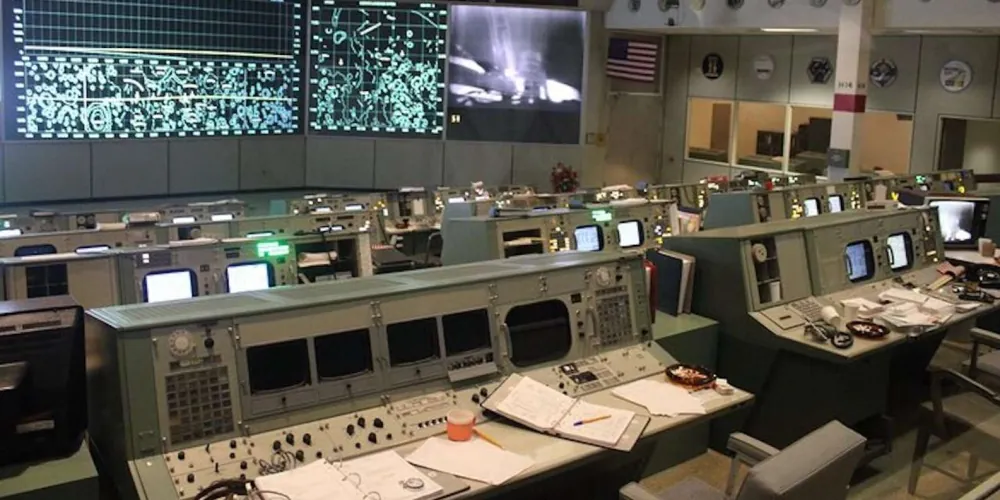
By 2015 the room where NASA landed men on the Moon had carpet held together with yellow duct tape.
Souvenir hunters had cut pieces out of the upholstery. Buttons were missing from the consoles. The National Park Service, which had designated it a National Historic Landmark thirty years earlier, formally listed it as threatened.
What you can see today is the result of a $5 million restoration so exacting that conservators recreated the carpet in a shade chosen to match years of accumulated nicotine staining, and tracked down the original wallpaper manufacturer to find the print roller still sitting in its warehouse.
This is the story of that room.
Historic Mission Control is a paid add-on to the tram tour, not part of general admission. It must be booked in advance and regularly sells out — the NASA Historic Mission Control Tram Tour + General Admission (from $100, 4.7★ · 169 reviews) bundles the two into one booking with free cancellation. For the booking mechanics, boarding passes and how the tram system works, see our NASA Tram Tour guide.
What the Room Actually Is
Its real name is Mission Operations Control Room 2 — MOCR, pronounced “moh-ker” — on the third floor of Building 30 at Johnson Space Center. During the Shuttle era it was redesignated Flight Control Room 2.
In April 2011, NASA named the whole Building 30 complex the Christopher C. Kraft Jr. Mission Control Center.
Who was Christopher Kraft?
Kraft invented the job of flight director. Not just filled it — invented it, along with the entire concept, structure and culture of Mission Control as an institution.
He was flight director for all six crewed Mercury missions, led the flight director team through Gemini and Apollo, and became director of the Manned Spacecraft Center in 1972.
He died on 22 July 2019, aged 95 — two days after the fiftieth anniversary of the Apollo 11 landing, and three weeks after the restored room he built was reopened.
Every mission run from this room
MOCR-2’s first operational shift was Gemini 4 on 3 June 1965.
From that console floor, NASA ran:
- Nine Gemini missions
- Apollo 6 (uncrewed test) and Apollo 8 through 17 — every crewed lunar mission
- 21 Space Shuttle missions, from STS-5 in November 1982 to STS-53 in December 1992
Then it was switched off. STS-53 was the last mission it flew.
A common confusion worth clearing up. Building 30 had two control rooms. MOCR-1, on the second floor, handled the Saturn IB missions — Apollo 5, Apollo 7, Skylab and Apollo-Soyuz. MOCR-2, upstairs, handled the Saturn V flights. Gemini 3 was run from the Cape, before Houston took over. So the room you visit ran the Moon landings, but not Skylab.
Landmark status
MOCR-2 was designated a National Historic Landmark on 3 October 1985, listed as the “Apollo Mission Control Center,” NRHP reference 85002815.
The plaque on the door reads: Mission Operations Control Room 2 / MOCR-2 / National Historic Landmark / Apollo Mission Control Center / Apollo 11 Lunar Landing July 20, 1969.
The Restoration
How it started
With a $5,000 grant application.
In 2013, JSC’s Historic Preservation Officer Sandra Tetley applied to the National Park Service Heritage Partnership Program for money to make a video about the Moon landing. That small application grew into a full preservation project.
Serious fundraising followed in 2016–17. The consoles came out in January 2018. Hands-on room work ran from November 2018 to July 2019, finishing in time for the Apollo 11 anniversary.
The ribbon-cutting was 28 June 2019, attended by NASA Administrator Jim Bridenstine and Apollo flight director Gene Kranz. Public tram tours resumed three days later.
Who paid for it
$5 million total:
| Source | Amount |
|---|---|
| City of Webster, Texas | $3.1m, plus a $400,000 matching challenge |
| Kickstarter campaign | $506,905 from 4,251 backers |
| Johnson Space Center | ~$1 million |
Webster is the town next door — home to a great many Apollo-era controllers and engineers. Its contribution was the largest single gift.
The Kickstarter ran for thirty days in July and August 2017 with a goal of $250,000. It doubled that, drawing backers from 25 countries.
The date the room was restored to — precisely
This is the detail most articles get wrong, so here it is exactly:
- The room — the walls, carpet, viewing gallery, front screens and overall appearance — was restored to 20 July 1969, the day Apollo 11 landed.
- The consoles — the panels, switches, indicators and monitors — were configured to their July 1971 Apollo 15 layout.
Why the split? Apollo 15 represented the technological peak of the programme, and it’s the configuration for which the most complete records survived. As NASA puts it, the consoles were restored to Apollo 11 but the technology displayed on the screens is that of Apollo 15.
Space Center Houston’s Mike Remar summed it up neatly: to the general public there’s no discernible difference — but to the controllers, there was.
The consoles went to Kansas
In January 2018, each console was catalogued, tagged by serial number and console position, and shipped to the Cosmosphere in Hutchinson, Kansas. Nineteen of them, roughly 1,200 pounds each, in two-tone green metal.
The original electronics were beyond saving. So conservators removed the cathode-ray tubes and button backlight assemblies — archiving every one as an artifact — and installed flat screens and LEDs behind the original faces.
The key principle was reversibility. As Tetley put it: they’re artifacts, and you don’t destroy artifacts. Everything was installed non-destructively.
The Cosmosphere fabricated missing parts in-house; their VP estimated less than 10% of the parts were made outside their own shop.
The forensic detail
This is where the project becomes genuinely remarkable.
The carpet. A fragment of the original was found under a pneumatic tube station. It went to the manufacturer, Shaw Floors, who recreated the exact shade — a colour chosen deliberately to reflect years of nicotine discolouration. The original was woven; the recreation used a modern tufted method with an extra yarn to match the texture, then was cut into 28-inch squares.
The wallpaper. A piece survived behind a fire extinguisher, another around a thermostat. The original manufacturer located the original print roller in its warehouse and ran off an exact reprint. Surviving original wallpaper was cleaned and left in place.
The rest. Ceiling tiles hand-stamped and recreated. Lighting replaced with dimmable LEDs so Apollo-era lighting levels could be reproduced without UV damage. Steelcase chairs re-cushioned and reupholstered to the original fabric. Original paint left where genuine, colour-matched where not. Hand-painted column markers uncovered and preserved.
Gene Kranz’s missing rotary-dial wall phone and his abort button were both replaced. “I fought for everything,” Tetley said.
The dressing. Each console was re-dressed to its individual controller’s known habits — the specific brand of cigarettes or pipe tobacco each man smoked, his coffee cup, his creamer, his headset, copies of his actual mission documents, many supplied by surviving Apollo 11 controllers.
Period items were hunted down on eBay and Etsy, including a “rocket” coffee pot found new in box. A building-wide scavenger hunt turned up more. The pop-out ashtray lids in the viewing gallery seats were recreated by 3D laser printing.
How they knew what it looked like. The room was kept dark during missions, so period photographs are grainy and unhelpful. The breakthrough came when an archivist located reels of 16mm film shot inside the room during Apollo 11 in the National Archives. Digitised, it revealed colours, objects and screen contents that no still photograph could.
Other Ways to Reach the Room
Mission Control sits on the Johnson Space Center campus, and the tram is the only way the public gets there — so the practical question is which booking gets you a seat. The Historic Mission Control tram bundle (from $100, 4.7★ · 169 reviews) is the direct route, reserving the restricted tram alongside general admission. If you’re travelling without a car, a round-trip shuttle from downtown Houston (from $67, 4.8★ · 301 reviews) covers admission and transport, and a NASA-expert-guided visit (from $96, 4.7★ · 62 reviews) adds a guide who handles tram strategy on the day. There is also a NASA Triple Play combining ticket, transport and the Mission Control tram (from $123, 4.6★ — but only 13 reviews, so treat it as unproven). Out along NASA Parkway, Rocket Park, Kemah Boardwalk and Galveston fill the rest of the day.
The Consoles: Who Sat Where
Four rows of gray-green consoles facing five large front screens. Each row grouped related functions.
The Trench — front row
The lowest row, closest to the screens, handling trajectory and dynamics. Trench veteran Jerry Bostick called it the first line of defence in crewed spaceflight.
| Call sign | Role |
|---|---|
| BOOSTER | Launch vehicle propulsion. Consoles emptied after trans-lunar injection |
| RETRO | Retrofire Officer — abort planning and return burns |
| FIDO | Flight Dynamics Officer — trajectory and manoeuvres. Widely considered the plum job |
| GUIDO | Guidance Officer — onboard computer and navigation |
It was GUIDO — Steve Bales — who gave the “go” when Apollo 11’s guidance computer threw 1202 alarms during the final descent, seconds from a possible abort.
Second row — the spacecraft systems
| Call sign | Role |
|---|---|
| SURGEON | Flight surgeon, crew health |
| CAPCOM | Capsule communicator — an astronaut, and the only voice that spoke to the crew |
| EECOM | Electrical, environmental and consumables |
| GNC | Guidance, navigation and control, command module |
| TELMU | Lunar module electrical, environmental and spacesuits |
| CONTROL | Lunar module guidance and propulsion |
Charlie Duke was CAPCOM for the Apollo 11 landing — the voice Armstrong and Aldrin heard. Sy Liebergot was EECOM when Apollo 13’s oxygen tank exploded. And TELMU became critical when the lunar module was pressed into service as a lifeboat.
Third row — flight direction
INCO (instrumentation and communications), O&P (operations and procedures), the Assistant Flight Director, FLIGHT — the flight director, holding ultimate authority — FAO (crew timelines) and NETWORK (the worldwide tracking network).
Back row — management and the public
PAO — the Public Affairs Officer, the “voice of Mission Control” heard on every broadcast — plus the Director of Flight Operations, the Mission Director representing NASA headquarters, and the Department of Defense manager.
Roughly thirty controllers were at the consoles during a lunar mission.
The technology
Two IBM 360 Model 75 mainframes ran the room. NASA’s own framing is that its flight controllers worked with less computing power than a modern mobile phone.
A pneumatic tube system shot memos and documents between consoles and the support rooms.
And behind the five front screens was the Summary Display Projection Room — nicknamed the bat cave — where slide projectors and Eidophor video projectors, a 1940s cinema technology, rear-projected maps, plots and television onto the screens. Above them, nine smaller screens showed clocks and numeric data through a mechanical stencil system that no longer survives.
What You Actually See
You view the room from behind glass, in the restored VIP viewing gallery.
Built in 1964, it measures 65 by 26 feet and seats 74 people in five tiered rows of theatre seating. Historically this is where astronaut families, dignitaries and press watched. Wernher von Braun watched the Apollo 11 landing from these seats. The front row had headset jacks so guests could listen to the flight loops.
The restored period details are the things people remember: the illuminated “Quiet Please” sign, and the little pop-out ashtrays in the seat backs — which younger visitors reliably mistake for phone holders.
The presentation
About fourteen minutes, covering five moments from Apollo 11: the descent and landing, the first step onto the surface, the reading of the plaque on the lunar module, President Nixon’s call to the astronauts, and the recovery after splashdown.
It uses genuine, digitally restored Apollo 11 mission audio — the recovered multi-track Mission Control tapes — synchronised to faithfully recreated front-screen data, maps and clocks, while the consoles relight around you.
One choice deserves credit. The presentation deliberately does not show dramatised or CGI footage of the landing. In 1969, those screens displayed only data and maps. Showing anything else would be a lie about the room. It’s a restraint that makes the whole thing more powerful, not less.
Practical points
- You cannot go onto the control room floor. Viewing is from the gallery only. Only retired flight controllers go out onto the floor now
- No bags are permitted inside, to protect the original furnishings
- Photography is fine — no tripods, monopods, selfie sticks, drones or long lenses
- The elevator was extended to the third floor years ago, and Space Center Houston describes the tour as wheelchair accessible. Confirm current arrangements with Guest Services if it matters
For opening hours, the last tram departure and the $10 parking charge, see our hours, parking and address guide.
The People Who Worked Here
Mission Control during Apollo was startlingly young.
Gene Kranz was 36 in 1969 — and he was the oldest flight director. He has said the average age of his controllers was 27; other accounts put it at 26. Either way, the people who landed humans on the Moon were mostly in their twenties.
NASA hired, in the words of Apollo controller Ed Fendell, every engineer who walked in the door. Flight director Glynn Lunney recalled that grade point averages and school names mattered less than whether you’d graduated.
They wore white shirts and thin ties, drank continuous black coffee, and worked in a permanent haze of cigarette, cigar and pipe smoke — which is why the carpet had to be recreated in a nicotine-stained shade.
The key figures:
Gene Kranz — lead flight director for the Apollo 11 landing and the Apollo 13 rescue. Famous for the white waistcoats his wife Marta hand-sewed for each mission; the Apollo 13 vest is now in the Smithsonian. He was flight director for Apollo 5, 7, 9, 11, 13, 15 and 17. He cut the ribbon at the 2019 reopening and has returned to sit at his old console.
Glynn Lunney — a flight director from the age of 28. His Black Team shift in the hours immediately after the Apollo 13 explosion he called the best work of his career. He died in March 2021.
Teams rotated through four colour-coded eight-hour shifts: white, black, maroon and green.
The restoration was personal for these men. Surviving controllers were consulted throughout, supplied documents and personal items, and still attend events in the room.
The Modern Mission Control
The active control room for the International Space Station is FCR-1, on the second floor of the same building — an Apollo-legacy room gutted and re-equipped in 2006.
It looks nothing like the room you visit. It’s a single level rather than tiered, operates 24 hours a day year-round, and can run with a minimal crew using consolidated super-consoles.
Building 30’s newer Station Operations Wing, opened in 1998, houses the White and Blue flight control rooms. The White FCR flew Shuttle missions and is now used for Artemis and lunar simulations.
Can you see it? Only on the higher-tier VIP tour, which — as covered in our tours comparison — is currently listed as unavailable. Verify before planning around it.
Why It’s Worth the Upgrade
Of everything at Space Center Houston, this is the one that reliably produces silence.
It isn’t a recreation or a themed experience. It’s the actual room, restored with archaeological precision, using the actual audio, in the actual seats where the families sat. The ashtrays are the ashtrays. The carpet is the right colour because someone found a scrap of it under a pneumatic tube station and matched the nicotine.
For roughly $15 on top of admission, it’s the best value in the building.
If you’re deciding what else to prioritise on the same day, the Saturn V at Rocket Park and the touchable moon rock in Starship Gallery are the other two exhibits people consistently name as unmissable, and both are included with admission.
Book it with your admission. The Mission Control add-on can’t be purchased on the day and sells out days ahead in peak periods. Add it when you buy your ticket.
Frequently Asked Questions
Can you visit Mission Control in Houston?
Yes — the restored Apollo-era Mission Control room is open to the public via a paid tram tour add-on from Space Center Houston. You view the room from the original VIP gallery behind glass rather than walking on the control room floor. The tour must be booked in advance and regularly sells out.
Is Historic Mission Control the real room?
Yes. It’s Mission Operations Control Room 2 in Building 30, the actual room from which NASA ran nine Gemini missions, every crewed Apollo lunar mission including Apollo 11 and Apollo 13, and 21 Space Shuttle missions. It has been a National Historic Landmark since 1985 and was restored to its 1969 appearance in a $5 million project completed in 2019.
What year was Mission Control restored to?
The room itself — walls, carpet, viewing gallery and front screens — was restored to 20 July 1969, the day Apollo 11 landed. The console panels and displays were configured to their July 1971 Apollo 15 layout, because that represented the technological peak of the programme and had the most complete surviving records.
How much does the Mission Control tour cost?
It’s an add-on of roughly $15 on top of Space Center Houston general admission, with members paying about half. It cannot be bought as a standalone ticket and must be reserved in advance — availability is very limited and it sells out days ahead during weekends, holidays and school breaks.
What is “the trench” in Mission Control?
The trench was the front row of consoles, closest to the display screens, staffed by the flight dynamics team: BOOSTER, RETRO, FIDO and GUIDO. They handled the launch vehicle, abort planning, trajectory and onboard guidance. A trench veteran once described the row as the first line of defence in crewed spaceflight.
Who was Christopher Kraft?
Christopher Kraft was NASA’s first flight director and effectively invented the role, along with the structure and culture of Mission Control. He was flight director for all six crewed Mercury missions and led the flight director team through Gemini and Apollo, later directing the Manned Spacecraft Center. Building 30 was named the Christopher C. Kraft Jr. Mission Control Center in 2011. He died in July 2019, aged 95.
How old were the Apollo Mission Control team?
Remarkably young. Gene Kranz was 36 during Apollo 11 and was the oldest flight director in the room; he has said his controllers averaged 27, with other accounts citing 26. Most of the people who landed humans on the Moon were in their twenties.
Can you see the current NASA Mission Control?
The active ISS flight control room, FCR-1, is in the same building but is not part of the standard tour. It could previously only be seen on the premium VIP tour, which is currently listed as unavailable. Verify current status before planning a visit around it.
See NASA's Home of Human Spaceflight
Join the visitors who rate Space Center Houston a highlight of their trip — the Saturn V rocket, Historic Mission Control, the world's largest public moon-rock collection, and Independence Plaza. Reserve timed admission with free cancellation.
Check Availability & Book