Astronaut Training: Inside Building 9, Where Crews Learn to Fly
What's actually on the floor of NASA's Space Vehicle Mockup Facility — ISS modules, Orion, a lunar lander cabin — and how astronauts train on it.
Rocket Park is the past. Historic Mission Control is history. Building 9 is what NASA is doing this week.
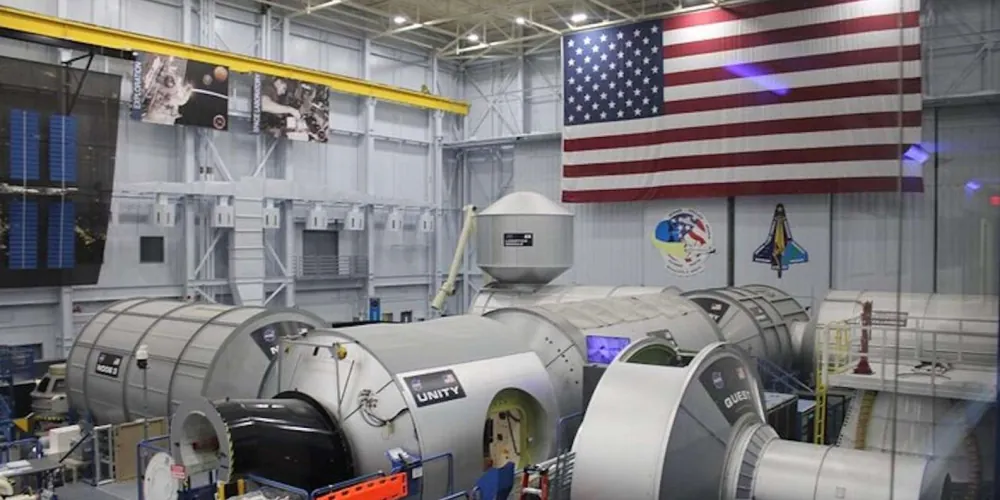
From an elevated walkway you look down on the actual hardware today’s astronauts train on — a full-scale International Space Station, an Orion capsule, and since 2026, the crew cabin of a lunar lander. Engineers work below you. Sometimes astronauts do too.
It’s the least polished stop on the tram tour and, for a lot of visitors, the most affecting. Nothing here is an exhibit. It’s a workshop.
Reached on the free Astronaut Training Facility tram route — included with admission, but boarding passes are first-come, first-served and the busiest route runs out. The ticket that gets you on it is the Space Center Houston Admission Ticket (from $29, 4.5★ · 3,846 reviews), the official timed-entry admission with free cancellation. Book the earliest slot you can and collect a tram pass the moment you’re inside — see the tram tour guide for how boarding actually works.
What’s on the Floor Right Now
Last verified: July 2026. This section dates faster than anything else in this guide — the floor is reconfigured as programmes change. Treat it as a snapshot.
The ISS Stack
The centrepiece: full-scale mockups of the International Space Station’s pressurised modules, which NASA describes as silver cylinders joined in a T shape. Each module is roughly the size of a school bus.
The set includes the U.S. Lab, the Nodes, the Permanent Multipurpose Module and the Joint Airlock, plus medium-fidelity mockups of the Russian Service Module, Soyuz and the FGB. Several international partner modules are represented too.
Look for the specific trainers scattered among them — they’re more interesting than the modules themselves:
- The Waste Management System trainer. The space station toilet. Astronauts genuinely have to be trained on it, and it’s harder than you’d hope
- The WORF rack — the Window Observational Research Facility, using the Lab’s nadir window
- The regenerative life support racks — oxygen generation and water recovery
- The Station Hardware Equipment Lab, holding a complete set of the maintenance tools available on orbit
Orion
A high-fidelity Orion crew module mockup, on the floor since 2011. Every piece of equipment is positioned within about one inch of where it sits in the real vehicle — because astronauts need to find things by feel in a cabin that might be dark or full of smoke.
The Artemis II crew — Reid Wiseman, Victor Glover, Christina Koch and Canada’s Jeremy Hansen — have trained in it, including documented deorbit preparation sessions in early 2025.
A Lunar Lander Cabin
The newest arrival, and the reason this stop is worth a second look if you visited a few years ago.
A full-scale mockup of the Blue Origin Blue Moon Mark 2 crew cabin — over 15 feet tall — became operational for training and testing in May 2026. It stands adjacent to the Orion mockup so crews can practise transitioning between the two vehicles.
NASA has said it will be outfitted progressively, so its configuration will keep evolving.
Don’t confuse it with the earlier one. A different, taller Blue Origin lander mockup — over 40 feet — was delivered in 2020 and left in early 2021. The current cabin is a separate, smaller piece of hardware.
Gateway
A HALO mockup — the Habitation and Logistics Outpost module for the Gateway lunar station — was delivered in December 2022 for human-in-the-loop testing, letting engineers refine the design with real crews inside it.
(A separate earlier HALO prototype was donated to Space Center Houston for public display inside the visitor centre. That one isn’t on the working floor.)
Commercial Crew
Boeing maintains a Starliner mockup trainer in Building 9.
SpaceX is a different story: Crew Dragon training largely happens at SpaceX’s own facility in Hawthorne, California, so Dragon isn’t a fixture here the way Starliner, the ISS stack and Orion are. If you’re expecting to see a Dragon, you probably won’t.
The Robots
Building 9 and its attached labs are where NASA’s humanoid robots live.
Robonaut 2 was built with General Motors, flew to the ISS in 2011, and came back to Earth in 2018 for repairs. Its lead developer was inducted into the NASA Inventors Hall of Fame in 2025.
Valkyrie — also called R5 — is the one you’re most likely to see. A bipedal humanoid standing about 1.87 metres and weighing 129 kilograms, with 44 degrees of freedom, originally built for the 2013 DARPA Robotics Challenge.
NASA and GM also built the Modular Robotic Vehicle, an all-electric concept car completed in 2013 that can drive sideways, and the Space Exploration Vehicle, a pressurised rover concept on the Chariot chassis.
Simulating Low Gravity
Three rigs address the same problem from different angles:
The Precision Air Bearing Floor floats objects on a cushion of air, simulating two-dimensional weightlessness for mass-handling practice — moving something that has no weight but plenty of inertia.
POGO, the Partial Gravity Simulator, uses servos, air bearings and gimbals to offload part of a person’s weight, reproducing lunar or Martian gravity. Victor Glover has been photographed training on it.
ARGOS, the Active Response Gravity Offload System, is the modern successor — an overhead bridge crane arrangement roughly 41 by 24 by 25 feet that can offload humans, suits, rovers and robots.
What Left
The Space Shuttle trainers dominated this floor for 35 years and went after the programme ended in 2011.
The Full Fuselage Trainer — 120 feet long, the largest mockup JSC ever built, and one that every Shuttle astronaut trained inside — went to the Museum of Flight in Seattle, with NASA formally handing over the “keys” in January 2012.
One Crew Compartment Trainer went to the National Museum of the U.S. Air Force in Dayton. One remains in Building 9.
The Building
The training hall’s real name is the Space Vehicle Mockup Facility — SVMF. Construction began in December 1965 and finished in March 1967, though it wasn’t built as a training facility at all. It originally housed the Technical Services Facility.
Its purpose kept changing:
- April 1969 — part of Building 9 was converted into a mock lunar surface, where Armstrong and Aldrin rehearsed the Apollo 11 moonwalk and practised setting up surface experiments
- September 1974 — Building 9A, the Mockup and Integration Laboratory, was completed for Shuttle-era mockups
- 1986–88 — a northwest extension added 32,000 square feet to house Space Station Freedom modules, the hardware that became the ISS
Whole mockups are craned in and out through an industrial door at the north end. Visitors have watched modules floating across the hall on the overhead crane.
On “every astronaut since 1980.” You’ll see this claim widely, including from Space Center Houston. It’s broadly true of the modern corps, but it’s marketing shorthand rather than a NASA statistic — NASA’s own history dates the building’s training role to the 1970s and its Apollo use to 1969.
Other Experiences Worth Pairing With Your Visit
The Building 9 catwalk costs nothing extra, so the questions that actually shape the day are how you get out to Space Center Houston and whether you hand the tram strategy to someone else. A round-trip shuttle from downtown Houston (from $67, 4.8★ · 301 reviews) bundles admission with transport and removes the parking question; a NASA-expert-guided visit (from $96, 4.7★ · 62 reviews) puts someone alongside you who can explain what you’re looking down at and get you into the tram queue early. If the restored Historic Mission Control is also on your list, the Mission Control tram bundle (from $100, 4.7★ · 169 reviews) reserves those separate tickets in the same booking — note it covers the Mission Control route, not this one. Combo tickets pair NASA with a downtown Houston city tour (from $98, 4.3★ · 522 reviews) or the Houston tunnel system (from $118, 4.9★ · 69 reviews), and the Houston CityPASS (from $72, 4.6★ · 265 reviews) folds the Space Center in with the Houston Zoo and the Museum District. Out in Clear Lake, Kemah Boardwalk is ten minutes down NASA Parkway and Galveston is under an hour south.
How Astronauts Actually Train
The Pipeline
Astronaut candidates — AsCans — go through roughly two years of basic training before joining the active corps and becoming eligible for a flight assignment.
Graduation requires spacecraft systems training, spacewalk skills, robotics, Russian language training, aircraft flight readiness, technical training with commercial partners, and team skills.
Then mission-specific training begins. For long-duration missions that adds another two to three years, with extensive travel to international partner facilities.
What Happens in the Mockups
The SVMF prepares crews for emergency operations, on-orbit maintenance, photography and video, stowage and handling, airlock and spacewalk operations, and scientific payload work. Space Center Houston puts the number of training courses run here at close to 200.
Crews rehearse timelines, practise repairs, and — critically — learn where everything is by feel. That’s why the mockups exist rather than simulations alone.
Fidelity varies by purpose. Low-fidelity mockups are fine for learning gross layout and stowage. High-fidelity units are required wherever a procedure must match the real vehicle exactly.
The Part Most People Don’t Know
Here’s what makes Building 9 more than a school.
Every mockup is available to support real-time troubleshooting when something goes wrong in orbit.
When equipment fails on the ISS, engineers work the problem on the ground using the same hardware, develop a fix, and relay it to the crew. It’s the permanent, institutionalised version of the Apollo 13 improvisation — which is why NASA keeps flight-accurate copies of everything it flies.
The Wider Training Network
Building 9 is one node among several at JSC:
| Facility | What happens there |
|---|---|
| Neutral Buoyancy Laboratory | Spacewalk training in a 6.2-million-gallon pool with a full-scale underwater ISS |
| Jake Garn Facility (Building 5) | The mission simulators — ISS, Starliner and Orion — which interface with Mission Control |
| Systems Engineering Simulator (Building 16) | Dome-based robotics and rendezvous simulation, capturing visiting vehicles with the robotic arm |
| Ellington Field | T-38 jet training |
The Jake Garn building’s high bay is where the traditional pre-launch cake-cutting ceremony happens.
Why Astronauts Fly Jets
Astronauts fly Northrop T-38 Talons from Ellington Field, and the reasoning is more interesting than it first appears.
Shuttle astronaut Terry Virts described the T-38 as the most important training astronauts do — because it’s the one place they aren’t in a simulator. It’s real flying, and mistakes have real consequences.
That’s the point. Simulators can be paused. A jet cannot. The habit of fast, correct decision-making under genuine risk is what transfers to spaceflight. In the Shuttle era, commanders and pilots flew at least 15 hours a month, and the jets also replicated the orbiter’s steep approach and landing profile.
International Crews
Yes — NASA lists international partners and commercial spaceflight companies among the facility’s customers. Astronauts from ESA, JAXA, the Canadian Space Agency and Roscosmos train here, and private providers such as Axiom Space have used the SVMF for their crews.
What You See From the Catwalk
You enter on an elevated, glassed walkway positioned directly above the training floor. Below you: the ISS stack, Orion, the lander cabin, whatever else is currently in place, and the engineers working on it.
Space Center Houston is straightforward that this is the only way the public can view the facility.
Will You See Astronauts Training?
Sometimes. They do work there during public hours, but there’s no guarantee on any given day — it depends entirely on the schedule.
Set expectations accordingly. The reliable reward is proximity to genuine, current spaceflight hardware. An astronaut sighting is a bonus, not the product.
Conditions
You’re behind glass, above the floor, so it’s quieter and more removed than being down among it. Photography is generally permitted, but crew will flag any restricted areas and you should follow that.
Because this is a working federal facility, the route is subject to availability and can be rerouted at short notice.
What Visitors Say
Reviews skew strongly positive — for anyone with real interest in the space programme, looking down on the actual ISS mockups is the highlight of the day.
The two recurring disappointments:
- Not catching live training — pure luck
- The distance. You’re on a catwalk behind glass. The premium VIP tour historically got small groups down onto the floor, which is a different experience entirely — though as covered in our tours comparison, that tour is currently unavailable
Correcting the Apollo 13 Myth
You’ll frequently read that the improvised CO₂ scrubber — the “mailbox” that adapted square Command Module lithium hydroxide canisters to the Lunar Module’s round fittings — was invented in Building 9.
NASA doesn’t say that.
The fix was designed and tested on the ground at the Manned Spacecraft Center by the Crew Systems Division. NASA’s own records credit the division and the centre, not a specific building.
It’s a JSC achievement, and a genuine one. But the Building 9 attribution appears to be something the internet added.
A Few Moments That Did Happen Here
- April 1969 — Armstrong and Aldrin rehearse the first moonwalk on a mock lunar surface
- March 1977 — astronaut Gerald Carr practises emergency egress from the Shuttle mockup
- 29 June 2011 — the final Shuttle training session, for STS-135
- January 2025 — the Artemis II crew train in the Orion mockup for deorbit preparation
Who Trains Here Now
NASA’s active astronaut corps is small — it peaked near 149 in 2000 and now sits at roughly a quarter of that. Recent figures have ranged from the high thirties to the high forties depending on the counting date and whether management astronauts are included.
The most recent class — NASA’s 24th, introduced in September 2025 — comprises 10 candidates selected from more than 8,000 applicants. Six women and four men, making it the first NASA class with more women than men. They’re currently working through their two years of basic training.
That selection ratio, roughly one in 800, is worth pausing on while you’re looking down at the floor they’ll train on.
Why This Stop Matters
Among the tram destinations, each does something different:
- Rocket Park — awe. The Saturn V, and what was achieved sixty years ago
- Historic Mission Control — history. The room where it happened
- Building 9 — the present tense
This is the stop that answers “what is NASA actually doing right now?” You won’t walk the floor, you won’t touch anything, and you may not see a single person training. But you’ll be looking down at ISS, Orion and lunar lander hardware that flight crews may have used earlier that week.
That’s a fundamentally different proposition from a museum replica.
Get your tram pass first. The Astronaut Training Facility route is the most popular free tram and runs out on busy days — see hours and planning for opening times and how early to arrive.
Frequently Asked Questions
What is the Space Vehicle Mockup Facility?
The Space Vehicle Mockup Facility, in Building 9 at NASA’s Johnson Space Center, is where astronauts train on full-scale mockups of the spacecraft they’ll fly. It currently holds a complete International Space Station module set, a high-fidelity Orion capsule, a Gateway HALO mockup, a Blue Origin lunar lander crew cabin, a Boeing Starliner trainer, humanoid robots and reduced-gravity training rigs.
Can you see astronauts training at Space Center Houston?
Sometimes. The free Astronaut Training Facility tram route takes visitors along an elevated, glassed walkway above the working training floor in Building 9. Astronauts and engineers do work there during public hours, but sightings depend entirely on that day’s schedule and aren’t guaranteed.
How long do astronauts train before they fly?
Astronaut candidates complete roughly two years of basic training covering spacecraft systems, spacewalks, robotics, Russian language and flight readiness before joining the active corps. Mission-specific training then follows, and for long-duration missions that adds a further two to three years, with extensive travel to international partner facilities.
Why do astronauts fly T-38 jets?
Because it’s the only training that isn’t a simulation. A simulator can be paused; a jet cannot. Flying T-38s from Ellington Field builds the habit of making fast, correct decisions under genuine risk, which is the mindset spaceflight demands. In the Shuttle era the jets also replicated the orbiter’s steep approach and landing.
What happened to the Space Shuttle mockups?
They left after the programme ended in 2011. The 120-foot Full Fuselage Trainer, in which every Shuttle astronaut trained, went to the Museum of Flight in Seattle. One Crew Compartment Trainer went to the National Museum of the U.S. Air Force in Dayton, and one remains in Building 9.
Is Robonaut at Space Center Houston?
Robonaut 2 is part of NASA’s Johnson Space Center robotics work rather than a museum exhibit — it flew to the ISS in 2011 and returned to Earth in 2018 for repairs. The humanoid robot visitors are most likely to glimpse from the Building 9 catwalk is Valkyrie, also called R5, a bipedal robot built for the 2013 DARPA Robotics Challenge.
Was the Apollo 13 CO2 fix invented in Building 9?
Not according to NASA. The improvised “mailbox” adapter was designed and tested on the ground at the Manned Spacecraft Center by the Crew Systems Division. NASA’s records credit the division and the centre rather than a specific building, so the widely repeated Building 9 attribution should be treated as unverified.
How many astronauts does NASA have?
Far fewer than most people assume. The active corps peaked near 149 in 2000 and now numbers roughly a quarter of that — recent figures range from the high thirties to the high forties depending on the counting date. The most recent class, introduced in September 2025, added 10 candidates selected from over 8,000 applicants.
See NASA's Home of Human Spaceflight
Join the visitors who rate Space Center Houston a highlight of their trip — the Saturn V rocket, Historic Mission Control, the world's largest public moon-rock collection, and Independence Plaza. Reserve timed admission with free cancellation.
Check Availability & Book