The Apollo Missions: What Houston Did
All 11 crewed Apollo missions, who walked on the Moon, and what Houston's Mission Control contributed — including the calls that saved Apollo 11 and 13.
When Neil Armstrong said “Houston, Tranquility Base here. The Eagle has landed,” he wasn’t speaking to NASA in general. He was speaking to a specific building — a specific room — in the Texas city where the mission was being run.
The rockets were built in Huntsville. They launched from Florida. The Moon landings were controlled from Houston. That distinction matters, and it’s why so many of the most important Apollo artifacts in the world are here.
This is the complete story — all eleven crewed missions, the twelve men who walked on the Moon, and the specific things Houston’s controllers did to make it happen.
See it in person. The only all-flight-hardware Saturn V, the world’s largest public moon rock display and the Apollo 17 command module are all included with general admission at Space Center Houston. The restored Apollo-era Mission Control is the exception — it’s a paid tram add-on that sells out — and the NASA Historic Mission Control Tram Tour + General Admission (from $100, 4.8★ · 173 reviews) books both in one go, with free cancellation. Our Historic Mission Control guide covers what the room shows today.
The Quick Answers
| Question | Answer |
|---|---|
| How many Apollo missions flew? | 11 crewed (Apollo 7–17) plus uncrewed tests |
| How many humans walked on the Moon? | 12 |
| How many humans flew to the Moon? | 24 (some went twice) |
| How many missions landed? | 6 (Apollo 11, 12, 14, 15, 16, 17) |
| How much rock did they bring back? | 382 kilograms from six sites |
| Who was last on the Moon? | Gene Cernan, Apollo 17, December 1972 |
Three Buildings, One Moon
Before the missions: a clarification that changes how you understand the programme.
Marshall Space Flight Center (Huntsville, Alabama) — Wernher von Braun’s team built the Saturn V rocket. Everything propulsion, everything launch vehicle.
Kennedy Space Center (Merritt Island, Florida) — assembled the vehicles, stacked them in the VAB, and launched them.
Manned Spacecraft Center (Houston, Texas; renamed Johnson Space Center in 1973) — designed the mission, trained the crews, and ran the flight. From the moment the Saturn V cleared the launch tower, the mission belonged to Houston.
That’s why Armstrong’s first words from the Moon’s surface were addressed to this city. (For how the working NASA campus and the museum fit together today, see Space Center Houston vs NASA Johnson Space Center.)
Other Experiences Worth Pairing With Your Visit
Most of Houston’s Apollo story sits inside one ticket, so the practical questions are how you get out to Space Center Houston and how much help you want once you’re there. The Space Center Houston Admission Ticket (from $29, 4.5★ · 3,866 reviews) covers Rocket Park, Starship Gallery and the moon rocks; a NASA-expert-guided visit (from $96, 4.7★ · 62 reviews) puts the stories on this page in front of the hardware they belong to. Without a car, a round-trip shuttle from downtown Houston (from $67, 4.8★ · 304 reviews) bundles admission with transport, and combo tickets pair NASA with a downtown Houston city tour (from $98, 4.4★ · 523 reviews). The Houston CityPASS (from $72, 4.6★ · 266 reviews) folds the Space Center in with the Houston Zoo and the Museum District, and Kemah Boardwalk and Galveston are both a short drive further down the coast.
The Missions, in Order
Apollo 1 — the Fire That Changed Everything
On 27 January 1967, during a ground rehearsal at Pad 34 in Florida, a flash fire swept through the pure-oxygen cabin of the command module. Commander Virgil “Gus” Grissom, Senior Pilot Ed White, and Pilot Roger Chaffee died.
The cause: an electrical arc from damaged wiring, igniting in a pure-oxygen atmosphere, inside a hatch that could not be opened quickly from inside. The crew had called their planned flight “Apollo 1”; at the widows’ request, NASA officially reserved that designation for them.
The consequences were total. A roughly 20-month redesign produced an outward-opening quick-release hatch, a nitrogen-oxygen launch atmosphere instead of pure oxygen, the removal of flammable materials, and far stricter quality control. The fire may well have prevented a worse disaster in space.
The planned February 1967 launch date is sometimes quoted as the fire date. It wasn’t. The fire was 27 January.
Why There Is No Apollo 2 or 3
Three uncrewed test flights had already flown before the fire: AS-201, AS-202 and AS-203 (all 1966). After Apollo 1, NASA decided not to renumber retroactively. The next mission — the first Saturn V test — became Apollo 4. Apollo 2 and 3 simply don’t exist.
The Uncrewed Tests
Apollo 4 (9 November 1967). The first all-up Saturn V test — all three stages live, on the first try. This alone was an extraordinary achievement. First launch from Kennedy’s Launch Complex 39.
Apollo 5 (22 January 1968). First flight test of the Lunar Module, uncrewed, in Earth orbit. Tested the descent and ascent engines that would land on the Moon.
Apollo 6 (4 April 1968). Second Saturn V test. It suffered severe pogo vibration and two J-2 engine shutdowns, but provided enough data to clear the vehicle for crewed flight.
Apollo 7 (October 1968) — the Shakedown
The first crewed Apollo flight, launched on a smaller Saturn IB rather than the Saturn V, spending 11 days in Earth orbit to wring out the Command and Service Module.
Crew: Wally Schirra, Donn Eisele, Walter Cunningham. All three developed head colds in flight and famously complained throughout. None of them flew in space again.
The spacecraft worked. That was the point.
Apollo 8 (December 1968) — Round the Moon and Back
The first humans to leave Earth orbit, the first to reach the Moon, the first to orbit it.
Crew: Frank Borman, Jim Lovell, William Anders. Ten orbits of the Moon. The “Earthrise” photograph. The Christmas Eve reading from Genesis, heard by roughly a quarter of humanity.
And then home. What the year 1968 needed.
Apollo 9 (March 1969) — Testing the Lander
The first crewed flight of the complete Apollo spacecraft, including the Lunar Module, but in Earth orbit.
Crew: Jim McDivitt, David Scott, Rusty Schweickart. They confirmed the LM could fly and dock — that the entire choreography of lunar orbit rendezvous would work.
Apollo 10 (May 1969) — the Dress Rehearsal
The full mission profile in lunar orbit, stopping just short of landing. The LM descended to about 15.6 kilometres above the surface and then ascended to rendezvous with the orbiting CSM.
Crew: Thomas Stafford, John Young, Gene Cernan. Cernan was later asked why they didn’t just land. The mission wasn’t designed for it; the lander was intentionally too heavy. Though he admitted it crossed his mind.
Apollo 11 (July 1969) — the Landing
Launched 16 July 1969. Landed 20 July. Crew: Neil Armstrong (commander), Michael Collins (Command Module pilot), Buzz Aldrin (Lunar Module pilot).
Armstrong stepped onto the surface at 10:56 p.m. EDT. He intended to say “one small step for a man.” Whether the “a” is audible in the recording is disputed — a 2006 audio analysis claimed to find it; other analysts disagree. The weight of evidence supports his intended wording. But it remains contested.
They were outside for about two and a half hours. They returned about 21.5 kilograms of samples. Collins orbited alone overhead for 21 hours, often described as the most isolated human being who ever lived.
What Houston did during the landing.
The Apollo Guidance Computer threw a series of alarm codes — 1202 and 1201 — during the final descent. “Executive overflow”: the computer was being given more work than it could handle and was shedding low-priority tasks to protect the essential guidance functions.
Armstrong’s radio call: “Give us a reading on the 1202 program alarm.”
In Mission Control, guidance officer Steve Bales — 26 years old — recognised from simulations that the alarm was survivable. He called it: “Go.” CAPCOM Charlie Duke relayed it to the crew.
The ultimate decision to continue or abort rested with Bales. He gave the go that put humans on the Moon.
Armstrong also overrode the computer’s landing target when he saw it was heading toward a boulder field, and flew manually to a safe spot while Charlie Duke counted down to the abort threshold. He landed with perhaps 25 seconds of usable descent fuel remaining above the abort margin.
Apollo 12 (November 1969) — Pinpoint Landing
Crew: Pete Conrad, Richard Gordon, Alan Bean. Landing site: Ocean of Storms.
What happened at launch. The vehicle was struck by lightning twice in the first 52 seconds of flight. The strikes knocked out the fuel cells and scrambled Mission Control’s telemetry into complete nonsense.
At the EECOM (electrical and environmental) console, John Aaron recognised a garbled data signature from an obscure earlier test and said: “Flight, EECOM. Try SCE to Aux.” Neither flight director Gerry Griffin nor CAPCOM Gerald Carr knew what SCE to Aux was. But Lunar Module pilot Alan Bean happened to know where the switch was. He flipped it, restoring telemetry, and the mission flew.
John Aaron is known in Mission Control history as the “steely-eyed missile man.”
Conrad made a pinpoint landing within walking distance of the Surveyor 3 probe, which had been sitting there since 1967. They brought back pieces of it.
Conrad’s suit — still in Houston. Pete Conrad’s Apollo 12 lunar surface suit, still visibly coated in Moon dust, is on display in the Astronaut Gallery at Space Center Houston. It is one of only two Moon-worn suits displayed outside the Smithsonian.
Apollo 13 (April 1970) — the Rescue
Crew: Jim Lovell, Jack Swigert, Fred Haise. The mission that never landed.
About 56 hours after launch, roughly 320,000 kilometres from Earth, an oxygen tank in the Service Module exploded after a routine stir command — caused by damaged insulation on the tank’s internal wiring.
Swigert radioed: “Okay, Houston, we’ve had a problem here.”
After Mission Control asked him to repeat, Lovell said: “Ah, Houston, we’ve had a problem.”
The present tense singular — “Houston, we have a problem” — was written for the 1995 film. It was never said.
The landing was aborted. The crew used the Lunar Module Aquarius as a lifeboat and made a looping return around the Moon to build up enough speed to reach Earth.
What Houston did.
Flight director Gene Kranz’s White Team was on console when the tank blew. They led the initial response. Glynn Lunney’s Black Team took the next shift and made the critical decisions about the return trajectory and power management. Lunney later called that shift “the best piece of operations work I ever did or could hope to do.”
John Aaron — the same controller from Apollo 12 — wrote the power-up procedure to revive the cold, dead Command Module for re-entry, cutting to under 12 amps a spacecraft that normally used 60.
The famous improvised CO₂ scrubber — the “mailbox” that adapted square Command Module lithium hydroxide canisters to fit the round Lunar Module fittings — was designed and tested by the Crew Systems Division at the Manned Spacecraft Center and relayed to the crew by voice instructions.
Gene Kranz’s line “Failure is not an option” was never said during the mission. It was written for the 1995 film. He later used it as his memoir title. His own phrase, from the speech he gave after the Apollo 1 fire, was “tough and competent.”
The crew splashed down safely on 17 April. The President awarded the Apollo 13 Mission Operations Team the Presidential Medal of Freedom.
Apollo 14 (January–February 1971) — Fra Mauro
Crew: Alan Shepard, Stuart Roosa, Edgar Mitchell. Landing site: Fra Mauro — the target Apollo 13 couldn’t reach.
Alan Shepard, America’s first man in space and the oldest person to walk on the Moon (47), played golf on the lunar surface — driving two balls with a makeshift club. He declared the second shot went “miles and miles and miles.”
About 42 kilograms of samples returned.
Apollo 15 (July–August 1971) — the Rover Arrives
Crew: David Scott, Alfred Worden, James Irwin. Landing site: Hadley–Apennine.
The first J-mission — extended surface time, extended scientific capability, and the debut of the Lunar Roving Vehicle. The battery-powered rover let the crew range far beyond where any previous crew could walk.
Scott and Irwin found the Genesis Rock, an anorthosite they believed was a piece of the Moon’s original crust. About 77 kilograms returned. Worden made the first deep-space EVA, inspecting the service module’s scientific instrument bay during the return journey.
Apollo 16 (April 1972) — the Highlands
Crew: John Young, Ken Mattingly, Charlie Duke. Landing site: Descartes Highlands.
Three surface EVAs, the rover driven about 26.7 kilometres, about 96 kilograms returned — the most of any mission except 17.
Duke later said about walking on the Moon: “It’s like a Sunday afternoon in the country, except the sky is black and you’re on the Moon.”
Apollo 17 (December 1972) — the End
The last Apollo mission, and the last time humans left low Earth orbit until Artemis II in 2026.
Crew: Gene Cernan (commander), Ronald Evans, Harrison “Jack” Schmitt — the first professional scientist to reach the Moon and the only geologist. Schmitt’s presence transformed the scientific return of the final mission.
Landing site: Taurus–Littrow, a valley between high mountains near the southeastern edge of Mare Serenitatis. Three EVAs totalling over 22 hours. The rover driven about 35.7 kilometres. About 115 kilograms returned — the most of any mission.
Schmitt climbed back into the lunar module first, the last scientist to walk on another world. Gene Cernan climbed the ladder after him, and became the last human to stand on the Moon.
He said: “As I take man’s last step from the surface, back home for some time to come, but we believe not too long into the future, I’d like to just say what I believe history will record: that America’s challenge of today has forged man’s destiny of tomorrow.”
It has been more than fifty years.
Why Apollo Missions 18, 19 and 20 Never Flew
Three missions had Saturn V hardware and planned landing sites.
Apollo 20 was cancelled on 4 January 1970, its Saturn V reassigned to launch the Skylab space station.
Apollo 18 and 19 were cancelled on 2 September 1970, victims of budget cuts and post-Apollo 13 wariness about risking more crews for diminishing political returns.
The hardware survived. The money didn’t. Stages built for those late missions are now in museums — including Houston’s Saturn V in Rocket Park, whose first stage was built for the cancelled Apollo 19 and which is the only Saturn V made entirely of flight-certified hardware. Our Rocket Park guide traces where each of its three stages came from.
What Houston Controlled
The Manned Spacecraft Center ran four overlapping functions:
Mission operations. The flight control teams in Building 30 — four colour-coded eight-hour shifts, roughly 30 controllers at consoles during a lunar mission — made every real-time decision about the flight once the vehicle cleared the launch tower. The flight director had, and has, unconditional authority: they may take any action necessary for crew safety and mission success.
Crew training. The astronaut corps was based here. Simulations, spacewalk training, systems familiarisation, survival training — all in Houston or on trips Houston organised.
Flight planning. The trajectory, the abort contingencies, the surface timelines, the rendezvous profiles — all designed in Houston.
Spacecraft oversight. While the contractors built the hardware, Houston engineers maintained detailed technical oversight of both the CSM and the Lunar Module.
The Flight Directors
Christopher Kraft invented the role and was Houston’s first flight director. By Apollo he was Director of Flight Operations — the senior manager — watching his teams work.
The Apollo-era flight directors named on this page, and their team colours:
| Flight director | Colour | Notable missions |
|---|---|---|
| Cliff Charlesworth | Green | Apollo 11 launch and moonwalk |
| Gene Kranz | White | Apollo 11 landing; Apollo 13 initial response |
| Glynn Lunney | Black | Apollo 11 lunar departure; Apollo 13 return |
| Gerry Griffin | Gold | Apollo 12 launch |
Gerald Carr, who sometimes appears in lists like this one, was on the other side of the loop: he was the astronaut CAPCOM talking to the Apollo 12 crew, not a flight director.
Lunney on his Apollo 13 shift: “The best piece of operations work I ever did or could hope to do.”
Kranz on what his team was: “tough and competent.”
The Science and the Legacy
The 382 kilograms of samples from six landing sites established things we didn’t know and couldn’t have known otherwise:
- The Moon is about 4.5 billion years old — essentially as old as Earth
- It was once molten to great depth, with a global magma ocean from which light anorthosite crust floated to the surface
- It is bone dry and depleted in volatile elements
- Its oxygen isotope ratios are almost identical to Earth’s — the closest evidence for the giant-impact hypothesis, in which a Mars-sized body struck the early Earth and the debris formed the Moon
The samples are still producing results. Modern instruments extract data from them that 1970s laboratories couldn’t, which is why geologists call the Apollo collection a gift that keeps on giving. Our moon rocks guide covers where they’re kept and which one you can touch.
Cost. About $25.4 billion in period dollars — roughly $257 billion in 2020 terms by NASA’s aerospace inflation index, or more than $600 billion measured as a share of GDP. At its peak, Apollo employed over 400,000 people and consumed 4.41% of the entire federal budget.
Why it ended. The space race had been won. Public and political enthusiasm waned. Vietnam and domestic priorities took the money. The hardware for three more landings existed; the funding did not.
Common Misconceptions, Corrected
“Houston, we have a problem.” Never said. The actual transmissions: Swigert — “Okay, Houston, we’ve had a problem here”; then Lovell — “Ah, Houston, we’ve had a problem.” Past tense. The film changed it.
“One small step for man.” Armstrong intended “one small step for a man.” Whether the “a” is audible is disputed by audio analysts. The weight of evidence supports his intent, but no analysis has settled it definitively.
“Failure is not an option.” Gene Kranz never said this during the Apollo 13 mission. It was written for the 1995 film. He adopted it for his memoir title. His own phrase was “tough and competent.”
The “30 seconds” call. During Apollo 11’s descent, Charlie Duke called out “60 seconds” and “30 seconds.” These were not seconds of fuel remaining — they were time to the mandatory abort threshold. Armstrong landed with roughly 25 seconds of usable descent fuel above the abort margin. The frequently repeated “seconds of fuel left” framing overstates how close it was.
Apollo computers vs phones. Accurate but understated. The guidance computer executed roughly 43,000 instructions per second and had about 4 kilobytes of RAM. A modern smartphone is millions of times more capable. The point isn’t that the computers were weak — it’s that brilliant software design let them do exactly what was needed. The 1202 alarm proved it.
The Apollo 1 fire date. 27 January 1967. February is the planned launch date, not the fire date.
Moon landing conspiracy. The landings are among the most thoroughly documented events in history: 382 kilograms of independently studied samples, retroreflectors still used today, telemetry tracked simultaneously by other nations, and Lunar Reconnaissance Orbiter photographs showing the hardware and astronaut tracks at every site. There is no credible scientific dispute.
What You Can See Today
At Space Center Houston:
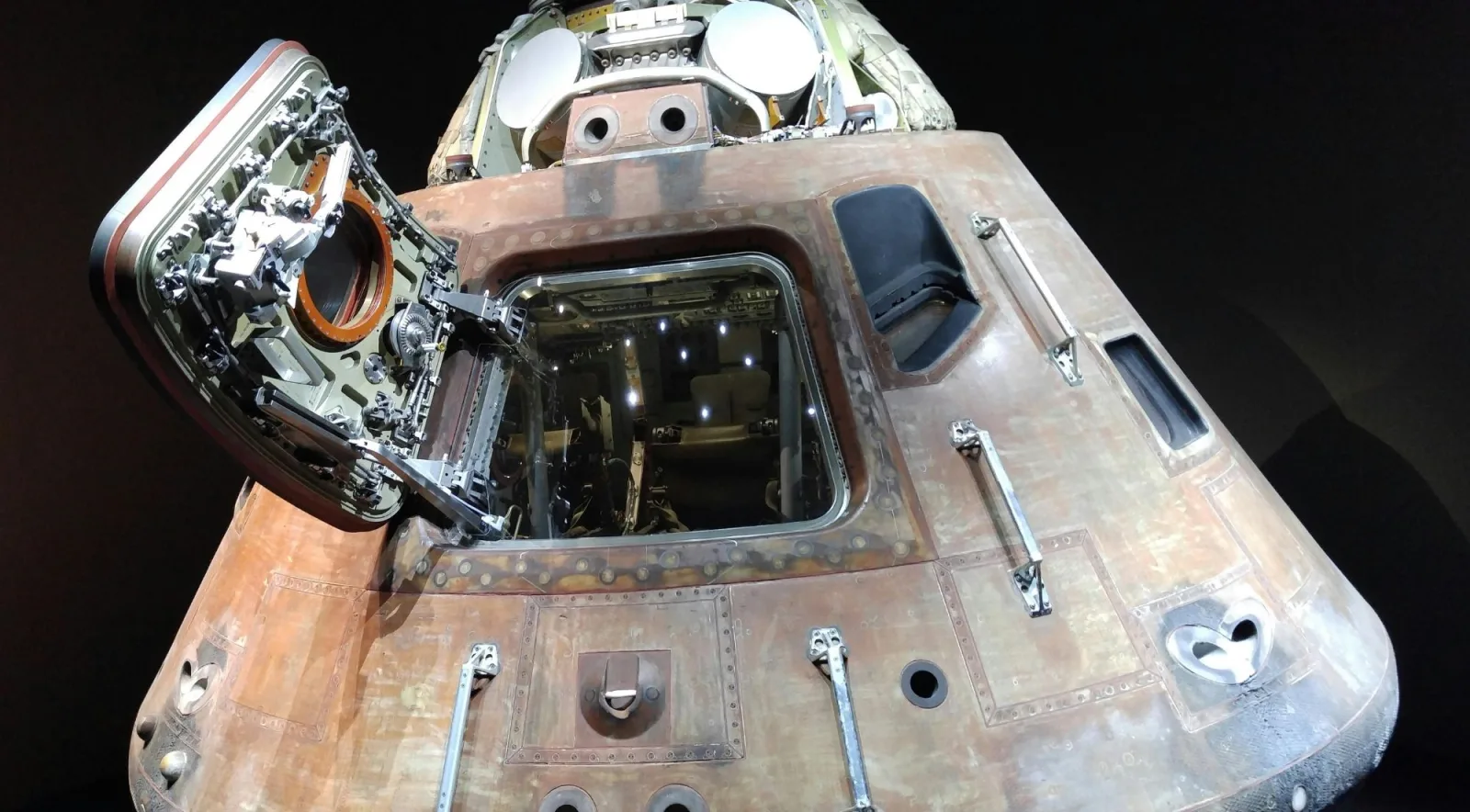
- The Apollo 17 Command Module “America”, the capsule that carried the last crew back from the Moon, in Starship Gallery
- A lunar module test article and a Lunar Roving Vehicle trainer
- The world’s largest public display of Moon rocks, in the Lunar Samples Vault — including a rock you can touch: a slice of Apollo 17 basalt 70215, 3.8 billion years old
- The restored Apollo-era Mission Control (Historic Mission Control) on the Historic Mission Control tram tour — the actual room, a National Historic Landmark, returned to its 20 July 1969 configuration. This is the one item on the list that is not included with general admission
- The Saturn V at Rocket Park — one of only three surviving, and the only one made entirely of flight-certified hardware
- Pete Conrad’s Apollo 12 lunar surface suit in the Astronaut Gallery, still visibly coated in Moon dust
See the companion guides for each:
- Historic Mission Control
- Rocket Park and the Saturn V
- Real Moon Rocks
- Independence Plaza
- NASA Spacesuits and the Astronaut Gallery
- Moon to Mars: Artemis and Orion
Plan your Apollo visit. Everything above except Historic Mission Control is included with general admission to Space Center Houston. See tickets and prices and hours and parking.
Frequently Asked Questions
How many Apollo missions were there?
Eleven crewed missions flew, numbered Apollo 7 through 17. There were also the uncrewed tests Apollo 4, 5 and 6, and the ground-test tragedy designated Apollo 1. There is no Apollo 2 or 3.
How many people walked on the Moon?
Twelve. Neil Armstrong and Buzz Aldrin on Apollo 11, Pete Conrad and Alan Bean on Apollo 12, Alan Shepard and Edgar Mitchell on Apollo 14, David Scott and James Irwin on Apollo 15, John Young and Charlie Duke on Apollo 16, and Gene Cernan and Harrison Schmitt on Apollo 17.
How many people went to the Moon?
Twenty-four humans flew to the Moon on Apollo missions. Three of them — Jim Lovell, John Young, and Gene Cernan — made the trip twice, though none of them walked on the surface twice.
Who was the last person to walk on the Moon?
Gene Cernan, commander of Apollo 17, on 14 December 1972. Harrison Schmitt, the mission’s lunar module pilot, had climbed back into the lunar module before him, making Cernan the last to ascend the ladder.
Why did Apollo 13 not land on the Moon?
An oxygen tank in the Service Module exploded about 56 hours into the mission, cutting off power and oxygen. The landing was aborted and the crew used the Lunar Module as a lifeboat to return safely to Earth, assisted by continuous real-time troubleshooting from Mission Control in Houston.
What is “Houston, we have a problem”?
A slight misquote, popularised by the 1995 film. The actual transmissions from Apollo 13 were “Okay, Houston, we’ve had a problem here” (Jack Swigert) and “Ah, Houston, we’ve had a problem” (Jim Lovell) — past tense, not present tense singular.
Why were Apollo 18, 19 and 20 cancelled?
Apollo 20 was cancelled in January 1970 to free its Saturn V for the Skylab space station. Apollo 18 and 19 were cancelled in September 1970 due to budget cuts. The hardware for all three missions existed; the funding did not.
What did Apollo find on the Moon?
The samples from six landing sites established that the Moon is about 4.5 billion years old, that it was once covered by a global ocean of molten rock, that it is extremely dry and depleted in volatile elements, and that its composition closely matches Earth’s — the strongest evidence for the giant-impact hypothesis that the Moon formed from debris when a Mars-sized body struck the early Earth.
How much did Apollo cost?
About $25.4 billion in period dollars — roughly $257 billion in 2020 terms by NASA’s aerospace inflation index, or well over $600 billion measured as a share of GDP. At its peak the programme consumed about 4.41% of the total federal budget and employed more than 400,000 people.
See NASA's Home of Human Spaceflight
Join the visitors who rate Space Center Houston a highlight of their trip — the Saturn V rocket, Historic Mission Control, the world's largest public moon-rock collection, and Independence Plaza. Reserve timed admission with free cancellation.
Check Availability & Book